Thursday, December 6, 2012

Post 4

The Bauhaus, "house of building" was a design school based in Germany founded by Walter Gropius and was the most significantly important influence in design. It combined the arts &crafts and all other styles of design that were previous and present and incorporated them into their teachings. They took the best from all the movements and created a dynamic approach to design teaching and design itself. The Bauhaus was greatly influenced by the previous arts & crafts movement as well as the Glasgow School, Art Noveau, Art Deco, Dejstill,  and constructivism. All of this condensed brought about the great designs that came out of the Bauhaus as well as the following teaching of form follows function which is extremely prevelent and important. What has been created or designed should have a functioning aspect that works. A reason behind something, why it is created and designed has a function to it. The Bauhaus also went through its own phases as well with the early phase being more of medievel craftsmanship and its late phase of new unity of art & technology. This is why it is to this day the single most important movement to design.


 Henri van de Velde was getting ready to resign as head of the Weimer Arts & crafts school and had recommended Walter Gropius to replace him as head of the school (which would later be renamed  Das Staatliche Bauhaus) or the Bauhaus. Walter Gropius was already well known for his designs in factory designs using glass and steel in new and improved ways(Meggs 328). Gropius was groundbreaking in finding a new unity of art & technology as mentioned. The teachers at the Bauhaus were also a dynamic factor as well in establishing there groundbreaking design unifying approaches with unity and technology.(Meggs 326
). One of these teachers was Lazlo Moholy-Nagy. Lazlo was a hungarian constructivist who studied law before getting into the arts and the Bauhaus and was exploring painting, sculpture, photography, film, and graphic design. (Meggs 328). He dabbled in new techniques in photomontage and the photogram, as well as kinetic motion and light which led to groundbreaking design and still influence design today in America and all over the world. In Lazlo Moholy-Nagy's photograms he uses light and the light becomes a medium for design and form which was way ahead of its time. Experimenting with these different mediums and in photography led to new and advanced design methods.

Some of the works we see that came out of the Bauhaus can be clearly seen as have been influenced by movements like Dutch Dejstill and russian constructivism. This is the case in Herbert Bayer when he designed the symbol for the Kraus stained glass workshop in 1923. The symbol is geometrically correct and has straight black lines and squares and rectangles that create a balance. In this symbol we can clearly see the influence of Dutch-Dejstill and mondrian's "Composition in red, yellow blue and black" 1921 with the same sort of straight black lines that create squares and rectangles but in mondrian's incorporates a balance of color with the red, yellow, and blue.These influences and unification of art & technology with all the movements from Europe and other areas made for the Bauhaus and its great influence that we see even to this day. Typography, furniture design, and graphic design even to this day are influenced by the Bauhaus even after being closed for over seventy years ago.

Case in point Joost schmidt's "Bauhaus Exhibition Poster" 1923 still has a great influence on design today. This poster combines Dejstill, cubism, and constructivism which shows evidence that the Bauhaus became a vessel in which diverse movements were melded into new design approaches (Meggs 328). Here we have two examples of modern day poster designs that were clearly influenced by the Bauhaus. Composition wise are very much influenced with the placement of the shapes and text and also the use of space.


Joost Schmidt Bauhaus Exhibition Poster 1923


Modern day poster
Modern day poster


Works Cited

Meggs, Phillip B. Megg's History of Graphic Design. Fifth ed. Hoboken: Wiley, 2012. Print.

www.smashingmagazine.com/.../bauhaus-ninety-years-of-inspiration/    


More Bauhaus inspired works


iBauhaus

         
             No one art movement had the bravery to swallow up the traits recognized by cubism, constructivism, de stiiji, and other movements alike. Claimed by its synchronicity, Bauhaus was an art movement like no other because it brought everyone together and steered aesthetics in a new direction. Until then, aesthetics were broadly defined by just being decorative pieces that accented other things. Their movement was mechanistic in philosophy, they abided by the rigid simplicity of de stilji, the organization of space that Cubism was known for, and when it came to dynamic movement they were influenced by the Futurists. Collectively Bauhaus inspired a motto that they are synonymously seen for – Form Follows Function.
             A brief historical capture of this important school of modernism gave art history a very short time period of living, from 1919 to 1933. Bauhaus encompassed a broad reach of different professionals, including architects, designers, fine artists, graphic designers and the like. All were part of this European movement that held Weimer, Germany as its epicenter. Established by Walter Gropius, a German architect, he founded the Bauhaus School when took the proposal by Henry van de Velde, at the time the ex-master of Weimer Arts and Craft School, to become the new Director of the Weimer Arts and Craft School.
             There, in a short period of time, he gathered up a wide range of individuals such as, Paul Klee, Johannes Itten, Herbert Bayer, László Moholy-Nagy, Otto Bartning and Wassily Kandinsky, all which served as faculty to the new school that we recognize as Bauhaus. of course, during the time period this school's ideals of freedom were an upset for the Nazi rise that was also occurring in Germany at the time forcing the school to move from Weimer to Dessau, Germany. Only eight years after their move to Dessau in 1925 the school closed down permanently due to the pressures of the Nazi Regime. 
(Bauhaus School in Dessau)
             The greatness of Bauhaus was its influence on all occupations that involved the arts, especially with the concept of mass production. There ideals of simplicity were found in the idea that if something was to be needed in large amounts than it would be necessary to make it easily reproducible. Their simplicity also attributed for why they stuck to using only squares, circles, and triangles as well as their philosophy for wanting to only use primary colors. 
             Bauhaus made giant contributions to the field of architecture. Contributing the ideals of favoring open space over mass, functionality over decor, and asymmetry over symmetry. The introduction of concrete as a viable material that could be molded and supported with rebar helped to innovate the designs that Bauhaus architects could come up with. Along with that there was the innovation of free standing structures, which was accomplished in architecture by using windows all the way around corners which were usually seen as area in which supported the roof. The Bauhaus school shows this in their own building design. The windows on the Bauhaus school also serve to show their implicit following of the grid pattern. 
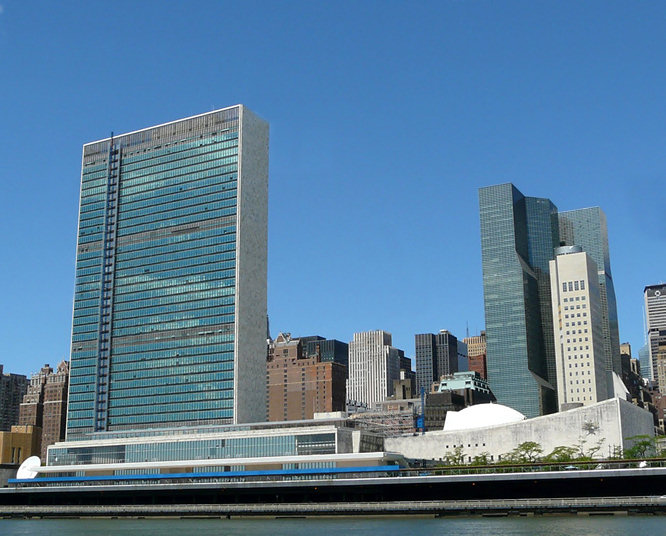
             In conclusion, there are two great examples of how the Bauhaus Movement influenced both architecture and industrial design. The United Nations Building in New York was designed by Le Corbusier. The status of what such a building represents shows the impact the movement had internationally. Further than that was the Bauhaus influence on company designs products such as Apple. Their Apple iPhone serves to follow the same motto in design that Bauhaus is known for, Form follows Function, and it is with this concept that the iPhone has become the most popular and wanted phone of all time.


Works Cited
Hunter, Sam. Modern Art. Third ed. New York: Prentice Hall, 2004. Print.
Meggs, Phillip B. Megg's History of Graphic Design. Fifth ed. Hoboken: Wiley, 2012. Print.

Bauhaus

As The Great War ended so did the reign of the German Monarchy and the censorship stronghold it had over artists. With this new found freedom Walter Gropius, with monetary help from the government, set out to make what he considered to be only a dream into a reality, thus creating the The Bauhaus or Building House. Gropius believed that artists, designers, and architects would benefit from working side by side and drawing from each others disciplines, and this could be accomplished in the school he would build. The main concept behind The Bauhaus was mass production; with the idea that art should go beyond aesthetics, it should serve a purpose, and that an object and its design should work together.

To better understand the importance of this school we must first look at its history and the events surrounding its creation. The Bauhaus was founded in 1919 in the city of Weimar, while at the same time about half of mile away the New German Constitution was being written. Weimar was very important, for both politicians and artists alike, because at the time it was considered to be the cultural heart of Germany. Within The Bauhaus’ walls many renown painters, craftsmen, sculptors, designers, engineers, etc. gathered to teach their combined knowledge in a political setting where each discipline was as important as the next. In 1925, after a political power change, The Bauhaus funding was cut in half and its staff put into six month contracts forcing the school to close and relocate.

Within the same year The Bauhaus re-open its doors, this time in Dessau and in a new school building designed by Gropius himself. The new building was made out of a steel-frame with windows so large they could be consider glass walls and it followed the functionality principals taught at the school. Here Gropius distributed studio, classroom, and administrative office space  for maximum efficiency ensuring that no part of the school would go to waste. This building became the embodiment of modern architecture and in it a new design era would be created. In 1928, three years after the school’s re-opening Gropius stepped down as its director, and asked Hannes Meyer to become the new director. Under Mayer’s direction the school’s architecture, photography, advertisement and design departments grew significantly but due to his affiliation to communism he was asked to step down and replaced by Ludwig Mies van der Rohe in 1930.


The school remained in Dessau for seven years until National Socialist German Workers’ Party took control of city’s Municipal Council and began to move against the school. By 1932, the school was facing financial hardships and was being pressured to close by the Nazi government. Ultimately, Mies was forced to downsize and relocate to Berlin where, using his own money, he turn a factory into the new school house. After less than a year in this locations, and with the Nazi party in complete control over Germany, the school was disbanded and its remaining faculty members were forced to flee to other parts of Europe and America.

Due to its unique collaborative approach towards art education, The Bauhaus was able to produce design solution that would’ve been impossible to achieve by one single person. Because of this almost every design/architecture program has adopted its curriculum and now teach classes such as color theory, 2D design, basic drawing, 3D design, etc. as part of their fundamental course. The Bauhaus was also the birthplace of many workshop techniques used by Schools of arts and crafts throughout the world today. And Though it operated for a little less than a decade in a half, its contribution towards architecture, art and design ha been so great that is easy to say that without it the world would be a completely different place today.


Hunter, Sam, John Jacobus, and Daniel Wheeler. Modern Art. Third ed. New York: Prentice Hall, 2004. Print.

Kleiner, Fred S., Christin J. Mamiya, Richard G. Tansey, and Helen Gardner. Gardner’s Art through the Ages. 13th ed. Vol. II. Belmont, CA: Wadsworth, 2004. Print.

Janson, H. W., Joseph Jacobs, and H. W. Janson. Janson’s History of Art: The Western Tradition. Upper Saddle, NJ: Prentice Hall, 2009. Print

Bauhaus at the last minute


The short lived but influential Bauhaus movement started at the art school of the same name founded by Walter Gropius in Weimar, Germany, in 1919. Bauhaus aimed to bring together all aspects of fine and applied art and design. The Bauhaus brought together artists from a myriad of different styles and backgrounds, they were able to share their unique perspectives to develop new innovative ideas.


Of course at that time new ideas and freedom of thought were not exactly popular with the government of Nazi Germany. So by 1925 the school was forced to relocate to Dessau and by 1933 the school closed entirely. However, like many great minds of Europe (Einstein for example), many of the teachers and students of Bauhaus fled to America to escape WWII and Nazi oppression.


The basic lasting influence of the Bauhaus movement is the emphasis on functionality in design. They stepped away from gaudy ornamentation and designed products to be easy to use and, through influence by the industrial revolution. easy to mass produce.


To this day you see companies like Apple or Ikea designing products with functionality and ease of use in mind. Focusing on visual communicate to allow products to be super accessible. 

The Bauhaus

by Krissia Keck

The Bauhaus was a movement that did not last very long, but had lasting impacts on all aspects of the art world. Founded by Walter Gropius in Weimar, Germany, Bauhaus aimed to bring together all aspects of art including but not limited to, architecture, sculpture and design.

The Bauhaus Dessau
The difference between Bauhaus and other movements, is that it does not have one specific “style”. Bauhaus aimed to “represent an amalgam of the fantasy of abstract Surrealism and the geometric vocabulary of Cubism, the absorption in science, engineering, and the new industrial materials of Constructivism.” (Hunter pg. 241). After WWI, Germany was economically devastated. A new wave of young artists were willing to step up, and make changes in their generation. In 1919, Gropius founded The Bauhaus, and even allowed women to enroll, which was something unheard of at this time. At first, the school concentrated on more handmade crafts, such as bookmaking and stained glass. Later, Gropius realized that the focus should be primarily in the efficiency of design for industrial production, thus uniting form and function.

Wassily chair by Marcel Breuer
In 1925 the school was forced to relocate to Dessau because of political pressure and disapproval. In 1928 Gropius resigned, and the future of the school was uncertain, until Ludwig Mies van der Rohe took over. Mies was easily influenced by the Nazi forces occupying Germany, and eventually the school was closed down in 1933. Many of the artists who taught and studied at the school were forced to leave the country, and many ended up in the United States, setting the stage for the modern art and architecture we've come to know today. 

Although the movement only lasted for a couple of years, it continues to be one of the most influential movements of all time. Bauhaus recognized that the world was changing, and the art world needed to reflect that change. Innovations made during the industrial Revolution allowed artists to revisit their designs and implement functionality where it had not been found before. Cubism and Abstractionism clearly influenced the geometrical shapes found in Bauhaus. Works during this period did not only evoke and emotion, but also needed to have a function. It was through this philosophy that many works achieved a timeless, modern look, and still look that way today, almost a century later.

Apple's iPhone 5
We can still see how Bauhaus continues to affect art and design. The most popular example of Bauhaus principles at work, is through the philosophies of Apple. Steve Jobs was directly influenced by Bauhaus,and even used Da Vinci's "Simplicity is the ultimate sophistication” phrase as the slogan for Apple. Apple products are known for their ease of handling, while simultaneously simplifying key functions for the customer. Apple stores have won numerous awards for their modern store designs, including the store on 5th Ave in New York City, which is made almost entirely out of glass. Jobs is also known for hiring a variety of different artists to help him develop new products. He united different people with different skills, in order to achieve a common goal: to create the most functional product without sacrificing the quality of design. Apple exemplifies what the Bauhaus movement stood for in the early 1920's. 

Sources:

Hunter, Sam, John Jacobs, and Daniel Wheeler. Modern Art. New York: Prentice Hall PTR, 2004. Print. 


Quick History: The Bauhaus & Its Influence. Anna Hoffman. December 4, 2012. < http://www.apartmenttherapy.com/post-241-93344>

The Bauhaus. December 4, 2012. <http://www.theartstory.org/movement-bauhaus.htm>
 

Post4: Bryan Choi


 Bauhaus         

            Bauhaus was an influential school for all types of artists, such as painters, architectures and graphic designers, and it have shaped everyone’s perspectives in solving the function of design. Bauhaus was unlike any other design institution because the school has combined various movements such as Cubism, De Stiijl, Constructivism, and etc. Bauhaus not only unite a broad range of movements, but have also gathered innovative artists in different associations to educate their perspectives in art. Covering such a broad range of movements have helped the students to get a strong sense in approaching arts and designs, and the ability for various artists to share their creativity to contain multiple tactics of ability. Even though Bauhaus no longer exist, but it have a huge impact that will inspire many artists, even till this day.
                         In order to get a better understanding of the Bauhaus, one should acknowledge the history of the school. Bauhaus was located in Weimer, Germany. Henri van de Velde, the Belgian Art Nouveau architect, have just resign his position in the Weimar Arts and Crafts School, so in April 1919 Walter Gropius, master of modern architecture, have combined the Weimar Arts and Crafts School with a Fine art school, and he named it Bauhaus. Gropius wanted a an entity of fine arts and applied art, as well as, new unity of art and technology, so he harness technology and oversee it by using brilliant ideas to justify the industry. In order to do so Gropius has gathered several artists in different locations of Europe, such as painters Paul Klee and Wassily Kardinsky and Lyonel Feininger, who practices De Stijl. During that period of time Nazi was having numerous issues with Bauhaus because they wanted traditional standards. The problems with the Nazi were getting more intense; therefore, on 1924, Gropius decided to move Bauhaus from Weimer to Dessau, which lasted a short period of time there (Meggs 327).
            The unique and vital traits of Bauhaus are the professors; they were gathered around different places in Europe; as well as different parts of the movements. A perfect example is an inventive constructivist, Laszlo Moholy-Nagy, who is passionate for typography and photography. He believes that photography is more objective, and painting is through the perspective of others. Moholy-Nagy unifies typography with photography to create an interesting visual communication and he called it “typophoto” (329). One of Moholy-Nagy works that perfectly portrays the characteristics of Bauhaus is Poster for Tires by 1923, this poster is a photograph combines with the type. The type is depicting as a shadow that was cast from the car, which the forms fit the function, since the poster is for tires and the car’s tire is forecasting the shadow of the typeface. The typeface is san-serif, which strips the decorative style of the design. Many Bauhaus designers wanted to get rid of traditional values, so any non-functional and decorative style will be stripped and simplified. The typography treatments show that there is a sense of motion because the type is getting smaller as it reach further back. The motion can be depicted as an inspiration towards technology, such as cinemas, the moving pictures that manipulate one’s eyes to believe that there is movement.
            With the treatments of photography and typography, it gives a sense of the form is fitting, and many post modernist respected that and have taken the idea of form having a purpose. A famous photographer Margaret Bourke-White has taken a photo for the first issue of Life magazine cover in 1936. In that image it shows different columns that form a fort, and the photo is taken in a diagonal position, so the column that is closer to the viewer is bigger. The layouts on the other hand, played with composition of the typography. The word “Life” is sheltered with a red rectangle, which can relate to the structure column. The diagonal of the photo leads to the logo of the magazine, so the composition of certain form that fits the function of hierarchy. Everything in that layout is exceedingly structured that creates a flowing unity (Hunter 258).
             In the 21st century, people are still inspired by the Bauhaus. The Bauhaus have an immense influence towards countless contemporary designers to become more simplified, structured, forms fitting the function, and the treatments with type and image. The famous singer, Pink/ Alecia Beth Moore, produced several of albums, and the layout for the cover indicates some features of the Bauhaus. In one of her album cover have a huge typography that spells out “PINK” that the color is also in pink, the photography of the artist is in black and white, which shows simplification. The treatment of the “I” in “Pink” is distorted to mimic the form of the artist’s arm. The typography is carefully placed, so the lines of the types match the shape of the artist. The whole layout was probably inspired from the Bauhaus in the usage of form fitting the function and the relationship between typography and photography.
            Overall, till this day designers, architectures, and various artists still seek inspiration from the Bauhaus because the school have numerous of ground-breaking educators that truly cares for the treatments of arts and applied arts. The artists have published countless works to show the important characteristic of the Bauhaus: structured, form fits the function, simplification, and overall creating a clear and concise communication with the artist, client, and the mass.  

PS: I am fully aware that some classmates are not Graphic Designers, but if you guys are interested in understanding more about history of Graphic Designer, I highly recommend to purchase Megg's History of Graphic Design.


Works Cited
Hunter, Sam. Modern Art. Third ed. New York: Prentice Hall, 2004. Print.
Meggs, Phillip B. Megg's History of Graphic Design. Fifth ed. Hoboken: Wiley, 2012. Print.

Post 4 Bauhaus- Eric Ng


          In the early 1900’s, when arts and technology were separating, an art movement brought the two back together again. Bauhaus was a combination of Cubism and Des Stijl. It sought to bring all sorts of artists from different backgrounds together. These artists thought about how “Form Follows Function” in all their pieces.  This means that all their work should have a nice easy flow that is easy to understand while still having purpose.
            The leader of the Bauhaus movement was a man named Walter Gropius. He designed and formed the Bauhaus School of Design. With the advancement in technology, more and more factories were being built, thus more machines were being invented to help make mass production easier. For centuries, fine arts and architecture walked side by side, moving along with the times. With this new advancement in technology, there was a slight division between the two of them. Gropius hoped to “…reunite the applied arts and manufacturing, and to reform education. “(Borteh) He designed the building with Form Follows Function in mind. He was very cautious of space and light. He designed each side of the building with glass walls, which filled up the building with natural light. Gropius designed the interior as well as the exterior of the building using the steel lines (beams) as geometric lines as in a Des Stijl painting. The building itself had the Bauhaus mentality all over it. Gropius created mass production in the sense that he called for steel beams and glass windows to be produced. He saw what painters were doing at the time and incorporated those styles within the architecture. His buildings had a simple, modern design.  In the end, Gropius wanted the arts to be one and work with each other again and he wanted the school to be a place were graphic artists, architects, fine artists and industrial designers collaborate and learn from each other.
            Bauhaus became one of the most influential movements of its time because architects were designing buildings that were running side by side with modern artists of the times. All of the sudden, people were starting to see Des Stijl and Cubism paintings come to life! These people were able to interact with these arts, going in and out of these buildings. It allowed the artists to manufacture their art in a way that was never done before- not only in architecture but in the visual arts too! Bauhaus taught designers and artists how to keep things simple while still having  huge impact and meaning behind their work. It is a lesson that young designers and artists are still learning today.


         Bauhaus still influences art, architecture and design to this day. Le Corbusier, who was one of the most influential architects (to this day), designed the Villa Savoye. It was a residential home to the Savoye family and is now a historical monument in France. At first glance, one would think that the home is floating. The indoor and outdoor space, play with each other in harmony.  The whole house was the Bauhaus form which plays with the geometric lines of Des Stijl and the organic forms of Cubism. The exterior strongly displays the geometric lines while the interior has the organic shapes. When one first walks into the room, he will notice the curved ramp that leads up into the house. The kitchen displays all of these same shapes that are found throughout the whole house. The sinks, faucets and bidet are all mass-produced. Anyone (during those times) could pick one of these appliances out at a hardware store and have it in their own home. In the bathroom, one can see the geometric shapes of Cubism within the tile wall and the geometric shape of the bathtub. The bathtub was one of the most popular and most wanted models at this time. Both the tub and the wall were really expensive and people all over wanted them.  
            Everything within the Villa Savoye had unity. The designs that one would find inside would also be found outside on the terrace. All the forms flow into nature and are one.  The architectural designs in and out of the Villa not only flow into each other, the furniture that Le Corbusier designed for the home was also a key part in continuing the flow. He designed the furniture in away that works with the home. He keeps his chairs simple by creating a simple lined structure (that one would see in a Des Stijl painting) and added his padding to it. Today we can see this in modern day furniture designers, such as Muller and Van Severen when they “…Collaborated to create Zetel(TheCoolist). The Zetel is a Bauhaus inspired piece, which is constructed with a frame and consists of cloth to hold people. On one side, there is a lounge chair while next to it is a regular chair. In between the two pieces is a built-in lamp. Everything about this piece has Le Corbusier’s influence in it.


            In conclusion, Bauhaus did accomplish what it set out to do. It brought the arts back along-side mass-production. It brought architecture to a whole new level where it has become the standard for our everyday living. Because of it, we have skyscrapers and fundamentals for design work. It made art into an interactive place where people can experience it first hand. Without Bauhaus, our modern world would be a very different place.


Work Citied:


Borteh, Larissa. TheArtStory.org. 2012. December 2012 <http://www.theartstory.org/movement-bauhaus.htm>.


(Hunter, Jacobus and Wheeler)

Photos:
Bauhaus School of Design
Villa Savoye
Zetel