Wednesday, December 5, 2012

Bauhaus (Post 4)


Inspired by a vision of bringing artists and craftsmen together to start a movement in art, which would change the future of the world, Walter Gropius opened the doors to Bauhaus. The year was 1919 when Gropius founded Staatliches Bauhaus Weimar. Germany was bankrupt after a devastating World War I and the younger generation was eager to make positive changes. Bauhaus, was a school in Germany that combined crafts and the fine arts, and was famous for the approach to design that it publicized and taught. It operated from 1919 to 1933. At that time the German term Bauhaus, literally "house of construction" stood for "School of Building".
Walter Gropius in Weimar founded the Bauhaus school. In spite of its name, and the fact that its founder was an architect, the Bauhaus did not have an architecture department during the first years of its existence. It was founded with the idea of creating a 'total' work of art in which all arts, including architecture would eventually be brought together. The Bauhaus style became one of the most influential currents in Modernist architecture and modern design. The Bauhaus had a profound influence upon subsequent developments in art, architecture, graphic design, interior design, industrial design, and typography. The school existed in three German cities (Weimar from 1919 to 1925, Dessau from 1925 to 1932 and Berlin from 1932 to 1933), under three different architect-directors: Walter Gropius from 1919 to 1928, Hannes Meyer from 1928 to 1930 and Ludwig Mies van der Rohe from 1930 until 1933, when the school was closed by its own leadership under pressure from the Nazi regime. The Bauhaus philosophy encouraged everyone to collaborate. In a radical move, women were allowed to enroll though they were almost exclusively placed in the weaving workshop. A unique feature of their program was the melding of handicraft and industrial production methods.
Some seminal Bauhaus designs include a 1923 model for public housing designed in a highly modern style, with light, airy and clean interiors, including a domestic kitchen designed by Benita Otte based on principles of scientific management. Breuer's Cesca chairs (1928) expanded his use of tubular steel around the house. Then there is the geometric tour de force of Marianne Brandt's teapot (1924), made by hand but intended as a prototype for mass-production. And Herbert Bayer's universal typeface (1926) was a perfect embodiment of Bauhaus ideas: simple, economical of form, legible and clean, and international no umlauts or capital letters to declare its German-ness. In Dessau, Gropius designed the famous Bauhaus building in an industrial aesthetic, with concrete and steel and a curtain wall of glass that we now recognize as the basic components of modern architecture. Through design, the Bauhaus sought a universal language of form that would break down the barriers reinforced by the recent World War 1.

The main influences behind the Bauhaus were modernism, the English Arts and Crafts movement, and Constructivism. Gropius reconciled these disparate influences at the Bauhaus, where the reigning principles were unity of form and function, the idea that design is in service of the community, and a belief in the perfection and efficiency of geometry. The Bauhaus was famously clutter-averse, teaching acolytes to discard the unnecessary, champion the streamlined and the utilitarian, and design always with mass production in mind. The democratization and Everyman aspiration of design shops, from Ikea to Muji, shows the influence of the Bauhaus They believed that if you combined modern design and practicality and utility, the public would be converted Bauhaus.
The great influence of the Bauhaus can still be seen around the world today. Much of what we call sleek, modern, utilitarian “international style” today can be traced back to the Bauhaus. Some say even the iPhone’s design comes to us indirectly via the Bauhaus. Besides the actual architecture and industrial design (lamps, furniture, graphics, appliances) of the Bauhaus, the word “Bauhaus” itself has taken on an aura of its own. Others have appropriated the name in many fields, from a British gothic rock band to a German home improvement store chain. The several variations of the Bauhaus typeface are all based on Herbert Bayer’s 1925 experimental Universal typeface.
 Art Deco: Tamara de Lempicka, The Musician & Michael Kungl, Americana Deco Coffee.
logos of Faboo Taboo and Axion

Hunter, Sam, John Jacobs, and Daniel Wheeler. Modern Art. New York: Prentice Hall PTR, 2004.


Tuesday, December 4, 2012

Post 3


The Newark Museum exhibit of “Angels & Tomboys: Girlhood in 19th-Century American Art” is the first to examine nineteenth-century depictions of girls in paintings, sculpture, prints and photographs.  The exhibition analyzes the ways that artists vigorously participated in the artistic and social construction of girlhood while also revealing the hopes and fears that adults had for their children. While the sentimental portrayal of girls as angelic, passive and domestic was the pervasive characterization, this project also identifies and investigates compelling and transgressive female images including tomboys, working children and adolescents.
Aimmi Phillips, Boy in Red ca.1832
             In the 19th century, parents often dressed young children in similar clothing, regardless of gender, such as putting boys in gowns. In the Ammi Phillips, 1832 ca painting “Boy in Red” the child is wearing a dress and has a short cropped hairstyle. Only if you look closely can you tell the sex: Many years later it becomes a theme that continues to resonate every time a little boy dressed in a yellow jumper gets mistaken for a little girl. Although we now use color often to determine which is the boy and the girl, this idea of childhood androgyny is still evident today.
Ammi Phillips (April 24, 1788 – July 11, 1865), a self-taught New England portrait painter, is regarded as one of the most important folk artists of his era. Ammi Phillips was known as a "limner". This was the name given to the best-known folk painters of 19th-century America who were nonacademic portrait painters, often itinerant, who usually worked in oils. The work from his 1812-1819 period is generally regarded as his first important creative period. Phillips was living and working in Dutchess County, New York, when he painted Girl in Red Dress with Cat and Dog, one of four strikingly similar portraits of children he produced. In each painting, the child wears a brilliant red dress over crisply pleated white pantaloons, with red or black slippered feet peeping past the sawtooth hems. Their arms cross their bodies in a diagonal parallel arrangement, and they sit with a sweet-faced dog lying by their feet. Three of the portraits depict young girls, each wearing two, three, or four strands of coral beads. Phillips is known to have used similarities of dress and other visual devices to indicate family relationships, The child's delicate neck and bared shoulders, accentuated by the four strands of coral beads, the double row of pleats on the pantaloons, and the lace trim on the sleeves, are indications of the extra care that Phillips lavished on the portrait of this unidentified child.
In Phillips's mature style, one may discern the simplification of geometric forms sometimes verging on abstraction, in addition to the sophisticated use of a limited color palette. The artist's black on black technique is particularly distinctive. Yet, each element of a Phillips portrait is readily identifiable, and the sitter’s personality is evident. This unique combination of abstraction and realism sets Phillips apart from his contemporaries.
The modernist movement, at the beginning of the 20th century, marked the first time that the term avant-garde, with which the movement was labeled until the word "modernism" prevailed, was used for the arts .Artists, like others were deeply affected by the devastating events of the early 20th century.  Some responded with energy and optimism and others with bleak despair.  Changes in the art world also influenced artistic developments.  The challenges of Impressionism, Post-Impressionism, and the various renegade and alternative exhibitions diminished the academies’ authority, thought they remained a presence.  Early 20th century avant-garde artists were in the forefront of aggressively challenging traditional and often cherished notions about art and its relations to society.  As the old social order collapsed and new ones ( such as communism and corporate capitalism) took their places, one of the self-imposed tasks school after school of avant-garde artists embraced was the search for new definitions and uses for art in a radically changed world. In general, the term modernism encompasses the activities and output of those who felt the "traditional" forms of art, architecture, literature, religious faith, social organization and daily life were becoming outdated in the new economic, social, and political conditions of an emerging fully industrialized world.
Henri Matisse, Laurette in a Green Robe (Black Background), 1916
The great French modernist Henri Matisse (1869-1954), in the early 20th century he led the brief blitz of the Fauves The term "fauve" is French for "wild beast," coined by art critic Louis Vauxcelles in reaction to the work of Henri Matisse and other artists of what became known as the Fauvist Movement in France. He gave them this name because of the bright colors, unfettered brush strokes and simple subject matter of the artwork, which made it appear wild and free, animal like in its nature. Those of fiery colors and blunt textures, paintings expressed emotion with wild often dissornant colors without regard to subjects’ natural color, but otherwise abstained from the signal movements of modern art. His palette is rarely less than original. He has a habit of painting dark colors over bright ones to create a subtle under glow and his frequent emphasis on blank canvas as a source of light and texture. Always he sought an implicitly modern directness and rawness that created a brave new intimacy among artist, object and viewer.
Similar to Aimmi Phillips technique and style Henri Matisse's artwork contained common subject matter, such as human faces and figures, but instead of using the skin tones and realistic colors, which were true to life, he used vivid uncommon colors to suggest feelings and notions of what the face was like. Both used color as the foundation for expressive, decorative and monumental paintings.


Modernism, Gender, and Historical Forces in the oeuvre of Alice Barber Stephens and Hanna Höch.


Urbanism, consumerism, innovation, experimentation, pragmatism, independence. These are all words that have been associated with all things modern. The unifying value of modernism could be arguably emancipation: from previous mores, hierarchical structures, way of thinking. The "modern man" values best his freedom to do, to think, and to be. Driven at its dawn by movements like the French Revolution, which emphasized the need to break from old traditions and structures, the modern age has emphasized the kaleidoscopic nature of reality. 

In art, photography's ability to render true two dimensional representations of a three dimensional world paved the way for the modern age of painting. Artists were now free to experiment with new techniques, subjects, and raisons d'être for their art. Throughout the modern age, advances in the sciences and technology as well as the new urban and consumerist culture that emerged, prompted artists to react to the changes before them. Two artists whose work exemplifies the core values of modern art are Alice Barber Stephens and Hanna Höch. Both artists choose to portray the modern reality of women in particular contexts using different techniques. 

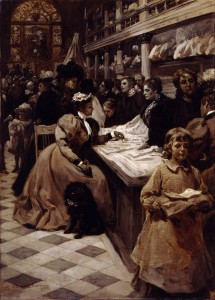
Barber Stephens's painting The Woman in Business, 1897 shows the viewer one of the ways in which reality was being re-defined for women at the onset of the 20th century. The scene is a department store in Philadelphia: women from different social classes crowd the frame, a young girl worker dominates the foreground, while one of higher status sits before a counter as she is helped by a saleswoman.  In this grisaille (monochromatic painting in shades of grey) Stephens presents the reality of the turn-of-the century woman as one filled with gender and social contrasts.

Alice Barber Stephens The Woman in Business, 1897


In the era of Gilded Age consumerism, the department store became one of the places created for women, this being emphasized in the painting by the fact that all the figures depicted are female. The department store allowed women to enter the public sphere by becoming consumers or sales clerks and thus take on a role separate from that of housewife and mother. The woman in business is truthfully articulated in this painting through her expressionless face, her plain attire, and her white and European looking complexion all the more emphasized by her juxtaposition to the seated and fashionably dressed shoppers. The counter serves in the painting to physically and metaphorically show the division of the two worlds inhabited by these women. 

The Woman in Business is also a testimonial to the working conditions of women and children at the beginning of the century. The fact that we see a child worker brings to the forefront the lack of child labor laws at the time and which would not be campaigned for until 1904. Sales clerks were also often fired for sitting down during working hours while shoppers were provided chairs. In this painting we thus see gender roles as they are defined by a particular person's purchasing power and social class. In Woman in Business Barber Stephens paints in the background what appears to be an ornate stained glass window. The viewer cannot help but think of the stained glasses of churches when looking at the painting and thus Barber Stephens effectively draws connections between the growing devotion to capitalist ideas and pursuits of the time in the United States. The grisaille technique used for the painting helps convey the division between the social classes depicted while the depth of the canvas gives the viewer a sense of the grandiosity of the place depicted. While the canvas is relatively small in size, its combining elements make it visually powerful.

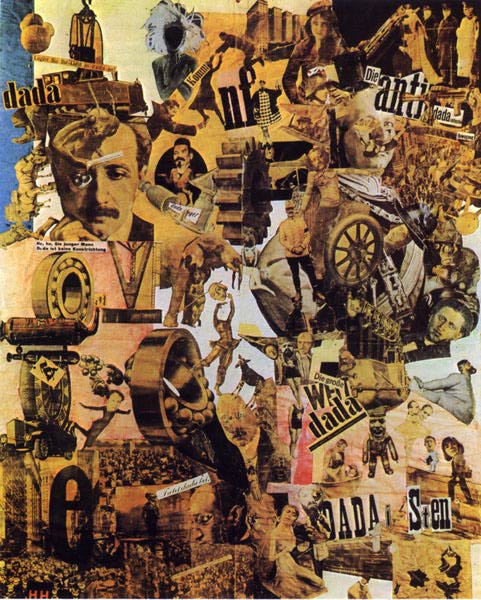
A direct reference to current social and cultural changes can also be found in Hanna Hüch's oeuvre. In her collage Cut With the Kitchen Knife, 1919 a development from initial modernist techniques and ideals in art is evident. World War I is the event that would shape a lot of the art production of the time and this work is no exception. The collage technique used serves to represent the political and social fragmentation that prevailed in Germany at the time.

Hanna Höch Cut With the Kitchen Knife, 1919


Sunday, December 2, 2012

Post 4


Mary Leriche
Development Of Mod Art
 
Post 4

Bauhaus is the name of a school that was located in Dessau, Germany. Gropius, who was considered the main founder of this school, was an artist working in the expressionist movement. The Bauhaus was considered one of the most influential modern buildings, providing in its educational plant a paragon of modern design and offering in its curriculum the ultimate model for the post academic “academy” (Hunter 206). Gropius had worked with another artist name Meyer before the war in a factory at Alfeld and Cologne, there they developed and expanded their own style, which Gropius integrated into the school. The Bauhaus came about during a tumultuous time in the world. During this time World War I was going on, and many different types of art styles were being developed in reaction to what many of these artists were experiencing. Since the Bauhaus was located in Germany, it was at the center of the affects of the war.

Gropius was part of many groups and met many different people who influenced him, which led to an influence of the Bauhaus school. One of the men Gropius met was named van Doesburg, and he settled for a short time in Weimar- the Bauhaus school existed in three locations over its lifespan due to political problems with the different towns it was located in during the rising tensions because of the war. Van Doesburg caused some dissension among the faculty and students but apparently influencing a stylistic shift there.

The Dessau building can be analyzed either as a nonacademic evolution by Gropius and Meyer from their prewar factories, which preserved traces of Behrens-like classicism in the midst of a progressive, innovative use of glass, or as constructive adaptation of the asymmetrical cubic assemblies of van Doesburg and his Dutch associates (Hunter 206). Both influences are apparent in the Bauhaus style. In 1928 Gropius resigned as director, turning the post over to Hannes Meyer, to devote himself to his architectural practice. The Bauhaus was not around for a long time. It began in 1919 and by 1933 the school was closed by the director due to increasing pressure from the Nazi regime.

The Bauhaus became one of the most influential movements in art and design history for many reasons. It started during a dynamic time in history in Germany, where a lot of upheaval was taking place with the Nazi regime and the strict rules that they started to place on all professions and aspects of the lives of those who lived there and in other countries that the Nazi’s controlled. The students and teachers who were at the Bauhaus during its short life were forced to flee Germany and the control of the Nazi’s, many of them came to America, where they had more freedom in creating their artwork and trying different experiments.

The Bauhaus was the first official school of art and design that had an academic system set up in that particular manner, and with the different ideas that were being taught there. To this day the Bauhaus’s curriculum is still used as a template in many colleges to teach fine arts. When the artists from the Bauhaus moved to other areas around the world they took their teachings and started their own schools, and took on new students, further spreading the ideas and styles of the original Bauhaus school, even though the school no longer existed as it once had. The artists also wrote books about the theories behind their style and those books are still used in colleges today to teach students about color theory, and art and design. The Bauhaus artists also built different architectural buildings and sites throughout America, and these places had a large impact and influence on the public, creating an interest in and helping to spread the impact of the Modern movement.


Herbert Bayer started as a student at the Bauhaus and then went on to become a teacher. He worked with posters, typography, and some architecture in his career. He fled here to America to get away from the war. His work is used a lot as an example of what the Bauhaus stood for and what its experiments entailed. The poster ‘Our Allies Need Eggs: Your Farm Can Help’ shows his experiments with san serif typography, the juxtaposition of horizontal, vertical, and diagonal lines, and there is some influence from Russian Constructivism from Bayer’s use of black, white, and red color accents.
 
 
By Herbert Bayer
 
The Bauhaus located in Dessau, Germany


The above piece is influenced by the Bauhaus style in that it is reduced to one color, red, and it is a modern sculpture that explores the relationship of between static movement and the shape created by horizontal and vertical lines. The simultaneously ascending and descending stairs twist around creating and interesting dynamic shape that captures the viewers eyes, while still having a simplistic quality to its form. The Bauhaus reduced the amount of color that was used in the artwork that it created, mainly using the three primary colors, and they focused on the three forms, circle, square, and triangle...or what at first was called the sphere, cylinder, and cone. The Bauhaus artists did many experiments with horizontal, vertical, and diagonal lines, and that experimental playful quality is present in this sculpture.


The Bauhaus:  For more information.


Sources:

Modern Art by Sam Hunter, John Jacobus, and Daniel Wheeler
History of Graphic Design by Philip B. Meggs, and Alston W. Purvis
Google Images
Wikipedia

Saturday, December 1, 2012

Object Of Frailty Or Strength Men Can't Comprehend


They say behind every good man is a great woman, yet men seem to rule society. Correction, they do, and it would seem that for the most part like every other industry that we have created in our society, both the creator and spectator were male. Throughout the ages we look back at the past, at art world specifically, and we can see that the female figure has been analyzed for everything it can be worth in its physical properties. That is to say that for a large portion of time we have only seen women as an object and not much was looked at past that. Now, in our self-proclaimed Modern times we invite the idea that we look at women with more depth. Understanding that they are and always have been the counterpart constituents of males.

In the Victorian ages we looked upon women with a glare, almost perverse in its lack of intimacy and sympathy for the female model. No different had the view been ages before that. There was a very rigid system that adhered the gender role of male to be superior to that of female. Leaving the female to be seen as subservient and needy. She was precious and important because she was fragile. Her roles as house wife, were seen to be appropriated to her adequacy, whether because a man had good intention of keeping his female counterpart out of stress or simply to empower his own ego, it cant be denied that back then, women were just plain sought out to be nothing more than the bearer of children and the housewife. But like every good system breaker, a person who breaks the ideals of a social construct and pattern, there were two female artists that had always done work that brought controversy, forced viewers to look at society apart from themselves, and pose the questions of what could actually be changed.

In our visit to the Newark Museum there was an interesting artist that had been shown in the exhibition on display called Angels and Tomboys, Lilly Martin Spencer. One painting in particular of her was famous for the capture of women during the civil war. The painting was important for it time because it demonstrated women in a different light. In the painting, War Spirit at Home, the depiction is of a grandmother that is drying off dishes while the mother is both tending to the newborn and reading the newspaper. The newspaper being a depiction of a woman who kept herself educated, mentally strong. The three children who play toy soldiers emulate the father’s bravery for being in the battle only furthermore compliment this. The painting itself holds at great amount of history for giving a reference of what women attribute during times of war, which is far from the nude poses that most artists painted just for the enjoyment of the male crowd.
By comparison, a few decades later an emerging Spanish artist that never really claimed the title of surrealist was making beautiful self-portraits that depicted a woman far from just joys of being posed in the nude. Frida Kahlo’s self portrait entitled, The Broken Column, shows a dreamlike landscape with a gruesome depiction of her own spinal injury. Well worth the shock value though is the idea that by her painting her own pain she was actually bringing the audience to her reality, the opposite of what surrealists were doing. Which was bringing audiences to the dreams of artists. During a time a time in which Freud’s psychology brought the idea of the subconscious mind in every one; artists would use this concept to interpret dreamlike landscapes and still lives that flipped normality’s into subjects that would cause awe, to the point of either being humorous or sickening. 
Frida’s work had this attribute but her life was something that by many would be considered a dream with her injuries, and tumultuous relationship with Diego Rivera, she lived a turbulent, passionate life that filled with heartbroken romance. That, until this day, can still be considered a dream to many of us but it is that gift of her biography that shows us a woman apart from just an object of attraction. That there was something more to a woman’s value emotionally, she would drink like a man would drink, lust like a man would lust, and hurt like a man would hurt. The fact that her life had embodied so many emotions helped respect the idea that her paintings were not just self-portraits but tales of all women. A small but important similarity in the artist is their topic of choice, women in society. Although, Frida’s self-portraits are more of stories about herself, she is a woman in society narrating her own story of what it is to be a female artist in an art world filled with men. While Lilly’s work contributes the narratives of the difficulties that women of average class in America faced.  Both contributed to paint a picture of women in society, one from the perspective of a viewer looking at women in society and the other with perspective of the viewer looking from within a woman at society.

In conclusion, defining modernism as a time period in history that we accept art as having more a social value constructed into it, it would be important to note how we see gender as topic in our own societies. Defined by culture, shaped by nature, and studied by science women, have made an impact shape our world by defining themselves as the strengths that men hold as weaknesses. Living in a Post- Modern society it is sad to see that the equality is still not fully there but at least the struggle will create a topic of inspiration for more women to rise. Make a voice about how women should be defined in society just as the brave women of past did, Frida Kahlo and Lilly Martin Spencer.

References:
Hunter, Sam, John Jacobus, and Daniel Wheeler. Modern Art. Third ed. New York: 
Prentice Hall, 2004. Print.
Newark Museum. Angels & Tomboys: Girlhood in 19th-Century American Art. Newark: 
Newark Museum, 2012.