Monday, November 5, 2012

Group 6

(Juliana Monteiro, Curtis Labrow)


Impressionism is a vaguely defined technique of painting and an attitude of individualism shared by a group of allied artists unofficially led by Édouard Manet. Impressionistic works, typically, included the following:

 1. The rejection of Chiaroscuro: as you all may recall Chiaroscuro is the modeling of form and space through light and dark gradation and contrast. Non impressionist painters would utilize a dark under painting and various thickness of paint to achieve the effect. However Impressionists like Monet utilized a light under painting and used a fairly uniform thickness of paint. This resulted in a reduction of tonal contrast and made the painting appear flatter.

2. The depiction of the interaction of light and color via working en plein air: prior to this point most painters didn’t paint outdoors. However Impressionists like Monet did works en plein air which means in the open air or outdoors. Monet and his associates discovered that outside they were better able to better capture the interaction of light and color, utilizing cool and warm colors to depict light and shadow.

3. The equalizing of brushstrokes across the surface of the canvas: most works at the time when submitted for display at Salons had smooth, clean, impersonal surfaces. However impressionistic works were characterized by their use of discrete patches (or taches) of color, resulting in a canvas densely clotted with paint and brushstrokes that varied in width, breadth, direction.

Our group also talked about the flanêurs and their influence on Impressionism, and we made a comparison of Impressionism with NYC street photographer Helen Levitt.


                                                                         Edouard Manet, A Balcony, 1868-9

Eisenman, Stephen F., Nineteenth Century Art - A Critical History

Helen Levitt Photography


Group 4 - Realism and Naturalism

 By: Krissia Keck, Alisa Lawrence, Eric Ng

Realism is the reaction to Romanticism. Artists of this movement rejected the idealized subjects of Romanticism, and sought to depict life as it really was. They also chose to represent peasants in their works, and illustrated the lives of the common people, who upheld the simple peasant virtues. Naturalism tends to focus on accurately depicting landscapes and the power of nature over the individual. Realism focuses more on the individual experience, and every day life. According to Eisenman: “The realist painter's role in the tragic drama was to undermine the elite class status of the genre by employing its scale, sophistication, and ambitiousness for the purpose of creating a new and politically contentious popular art intended for an audience of workers and peasants.” One of the greatest Realists was Courbet, who was often criticized for his extremely large paintings of subjects that deemed "unfit" to be portrayed in such majestic way: The struggling working class.

Presently, Kathryn Mapes Turner is a naturalist who describes her creative process as a "confluence of nature's inspiration and my personal interpretation of what I am experiencing. I strive to create paintings that record my own experience of the subject's essential spirit and energy, not an imitation of a fixed surface reality."Other contemporary artists such as Shepard Fairey and Kevin Doyle, are influenced by Social Realism, and depict the working class in their pieces. These artists have without a doubt, been influenced by the Realism and Naturalism movements of the 1800's. 


Kathryn Mapes Turner. Trumpeter Swan.


Works Cited

Eisenman, Stephen M. Nineteenth Century Art: A Critical History. 4th ed. New York, NY: Thames & Hudson, 2011.

Turner, Kathryn Mapes. Artist's Statement. Turner Fine Art. November 5th, 2012. <http://www.turnerfineart.com/portfolio/about/>

Sunday, November 4, 2012

Group 2 - Francisco de Goya

Alejandro Hincapie, Kendra Wells, and Marcos Hallo


In our presentation, we made a clear connection between the work of 19th century Spanish Romantic artist Francisco de Goya and the current atrocities taking place in Syria as part of the greater Arab Spring. Goya’s work, particularly Third of May, 1808, shed light on the atrocities French military forces committed in their invasion of Spain. Using light and composition to create a careful weighing of the importance of individuals within the work, Goya attempted to generate an emotional response from the viewer—the greater goal of all Romantic works. Sympathy for the victims and unconscionable horror towards their perpetrators are the particular emotional reactions aimed for in Goya’s work. Similarly, the flood of images coming in from civil war ravaged Syria express the horror of the events currently taking place there. Juxtaposed against Goya’s work, they make a statement about the power of visual media, whether fine art of journalistic photography, in creating an emotional response in viewers towards particularly events. 


Works Consulted

Eisenman, Stephen, and Thomas E. Crow. Nineteenth Century Art: A Critical History. London: Thames and Hudson, 1994. Print.

Photographs compiled from Time.com

Group 1: Princess Hickmond, Bryan Choi, Steven Goncalves


"Neoclassicism v.s. Romanticism"

Our group presentation was based on the comparison of Romanticism and Neoclassicism, using a modern classroom scenario. Two students, Bryan Choi and Steven Goncalves, have very opposing perspectives of art and each of them represented an artistic movement. Bryan Choi, organized and structured, was a studious student much like the academic neoclassical painters; on the other hand, Steven Goncalves was laid back and expressive like Romantic painters. Princess Hickmond, the teacher who favors Steven more than Bryan because she symbolizes the masses during the time. As the era moves forward, people favored interpretive, fresh quality of Romanticism more so than the mathematical, historical neoclassical artists of this time. This is why Princess feels more passionate towards Steven’s response in the classroom.  Also, the comedic aspect of the play was meant to keep the classroom intrigued so that they could learn more about the topic. 

 Work Cited

Eisenman, Stephen M. Nineteenth Century Art: A Critical History. 4th ed. New York, NY: Thames & Hudson, 2011. Print.

Wednesday, October 24, 2012

Gender and Art

To put certain ideas in perspective, the emergence of such disciplinary courses like “Women’s Studies” and “Gender and Sexuality Studies” slowly entered our curriculum only a few decades preceding the 21st century. Historians have always socialized a view of history where men existed and women occupied the sideline. Finally, slowly but surely, historians are reexamining the texts and acknowledging influential women and their contributions. Nonetheless, recognition is not the only component as to why women are hardly recognized for their feats. The social structure we abide by—willingly and unwillingly—is patriarchal. Therefore, the gender of a female painter already causes difficulties.


Art history flows through a series of constant actions and reactions. Following the era of Realism, Impressionism was a headstrong and perceptible riposte wrapped in hasty brushstrokes and optical effects. Henry David Thoreau wrote in his journal, “The question is not what you look at, but what you see.” While Realism focused on actual representation of ordinary social themes, Impressionism sought visual representation of what laid before them. In short: Realist painters attempted to present what they saw and Impressionist artists depicted how they saw. Although Realist painters respected the academic traditions of antiquity, they rejected the hero-complex glorification of people and events. On the other hand, Impressionists rejected much of the Classical tenets in favor of “painting for painting’s sake.”

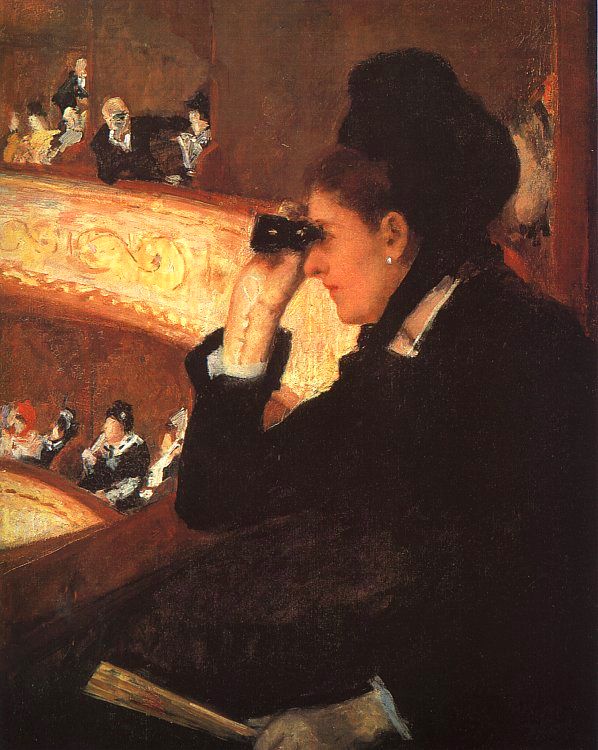
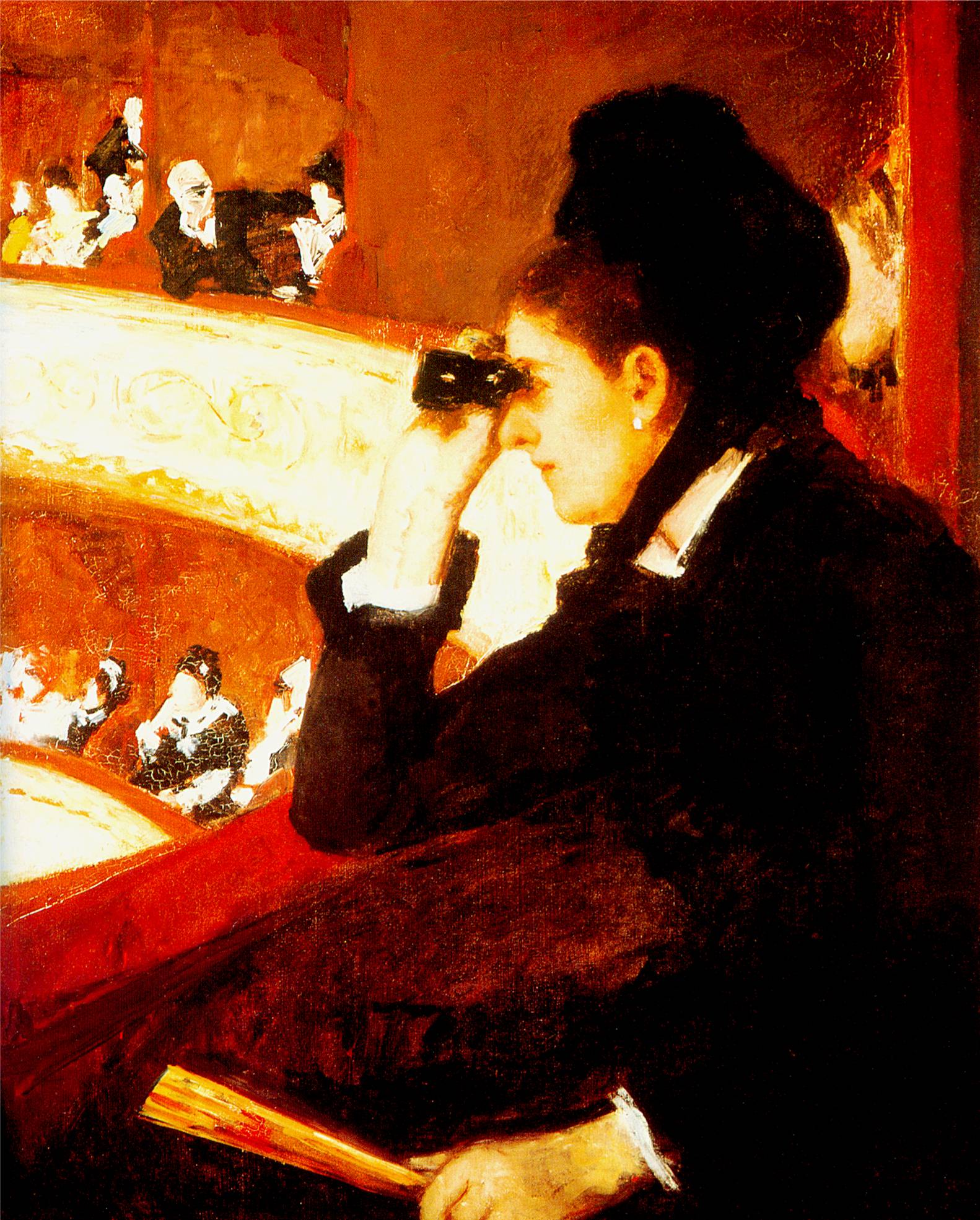
Although Mary Cassatt was not a native Parisian Impressionist—nor of the male gender—she is upheld as one of the milestones of the Impressionist movement. Woman in Black at the Opera, a vertical-fixed oil painting by Cassatt, is most commonly discussed within feminist dialogue. In some ways, Woman in Black was one of Cassatt’s well-crafted protest songs. The spectator engages with the painting as a passive bystander. The main subject is the woman; she dons a black bonnet and black dress. Unlike the other women in the painting, even her white garments are hidden within her black attire. In doing so, she is able to mask herself in the darkness and anonymity. A few booths away, a man seems to be entranced and intrigued by her presence—for he is leaning out of his box with strained posture. Woman in Black at the Opera was painted in 1880—a time when women did not have independence or social authority over their own lives. Therefore, we can speculate that this man is either bemused or astonished by her bold company. As the woman in black watches the opera through a lens, the male and his male gaze passes unacknowledged.

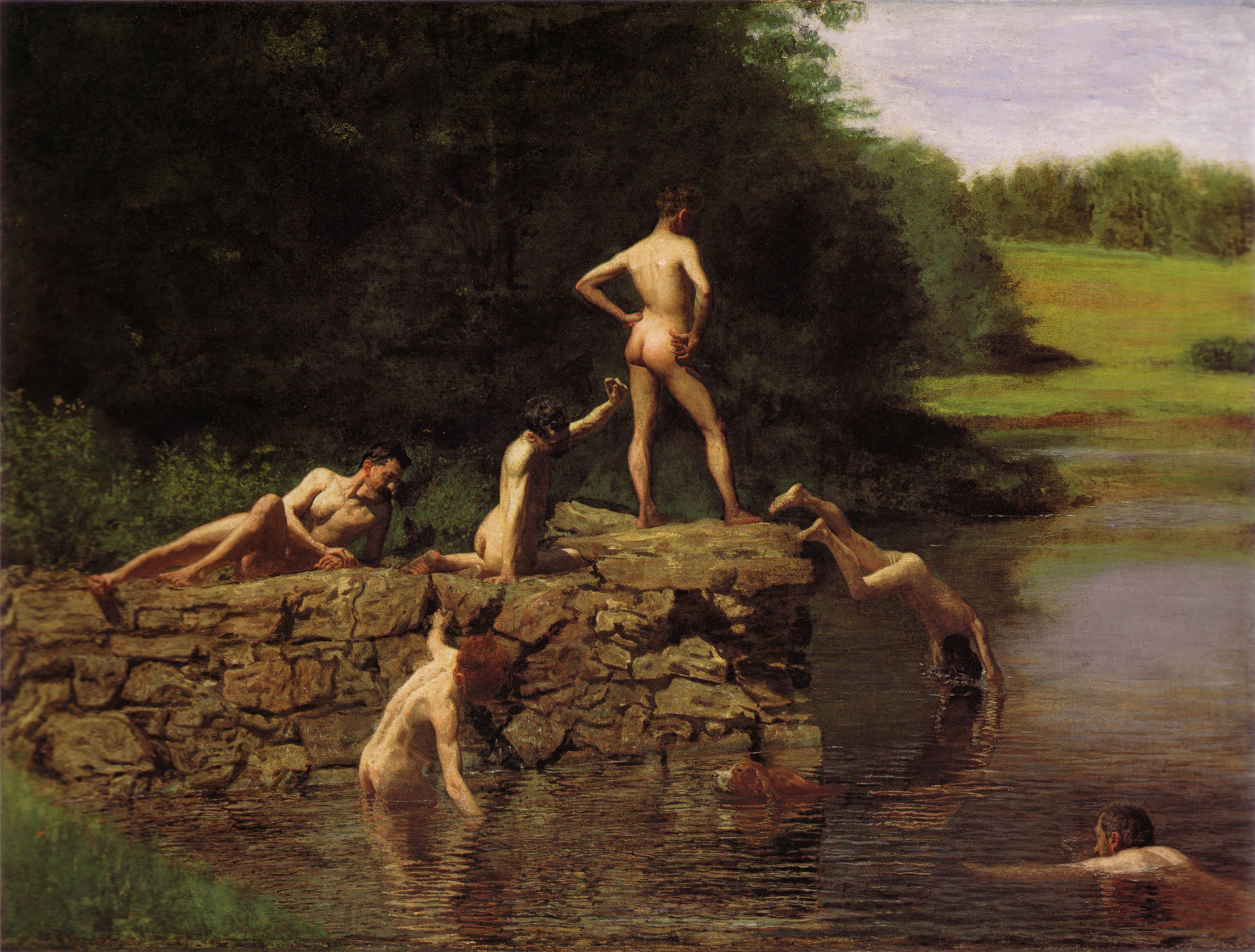
In comparison, Thomas Eakins, a fellow American Realist painter, painted homage after homage to men of different ages and class—yet the common denominator was the unquestionable power of these men. In 1885, Eakins presented The Swimming Hole. The horizontal oil painting depicts a group of young men enjoying the cool waters of the lake on a warm day. The pyramidal composition consists of dark shadows of the trees and lake water; all punctuated by the pale bodies of the young men. Eakins introduces a few concepts: man’s conquest of nature, hegemonic masculinity, and homoeroticism. The man located at the edge of the rocks stands tall with his hands planted by his hips. Although he is unaware of the spectator, he exudes dominance as he looks onto the water and trees. To his right, a man dives into the water and Eakins chose to capture the moment he breaks the water: nature cannot keep man out of its bounty. The absence of women in this painting speaks volumes—women do not have the freedom nor the virtue of achieving or innovating America's future. The Swimming Hole clearly translates the Platonic philosophy that higher thinking and immortal triumphs solely belong to men.

Tuesday, October 23, 2012

HEY MARY MARY!!!


            In the beginning of the 19th century art, painting reached a pivotal point in its history that would drastically change what the criteria for what painting actually meant. What could be dignified, appreciated, and accepted by many had changed; the death of Realism and the birth of Impressionism had begun. Alongside this change came societal, political, and cultures values that were rocked to a point of unease. Women back then were very much regarded as a beneath men, incapable of any abilities that could rival men. With this outlook, it was evident why men vastly outnumbered women in the art world and why women played a very specific role in art as well. Of course all this was about to change.
            To begin with, a brief recap on the history of impression and what art movement it opposed. As it seems all-small art beginnings have; they fight their way until they become accepted by whatever institution is currently reigning. Impressionism started out as a protest against Realism in France, as a revolution against all the fine art academia that up held strict standards and only allowed certain types of painting into the galleries that were well known. This set the groundwork for what we now call Impressionism and such artists like Manet, Monet, Cassatt, and Eakins to become popular today. In America we faced different struggles as women sought that they should also play a role in art as artist, and as subjects other then object of beauty in nude to be gawked at. Mary Cassatt was instrumental in this endeavor. But all together impressionism wanted to divert from the rigid formalities that Realism imposed. No more subjects that focused on depicting the poor, the average American lifestyle, or the difficulties of man. Especially, when there were other people in society that were being neglected too, the women.
            See, back then women in paintings, this isn’t the case for all but for the vast majority, were seen in the nude. The nude was an active depiction, which artists intentionally made for the purposes of attracting the male gaze. This is where Mary Cassatt debuted her spotlight. Creating works that depicted women in different roles other than being nude. One of her most controversial works, “Woman in Black at the Opera” was an oil on canvas masterpiece of social commentary that stood 31” x 25” in frame. The painting depicted a woman dressed in all black, which was unusual since during that time period the women wore exuberant gowns and jewelry to be seen by everyone.While men wore black suits to hide in the shadows and stare at women without being seen. In this painting we see how the main character, the woman in black, takes the role of a male and goes to the opera dressed inconspicuously, paying no attention to other men and looks at the performance from above. It can be thought of that she might have been alone as well and that for her own security she dressed in all black, rejecting the accompaniment of a male partner. We also see the in background the male spectator that still can’t control himself and looks through his binocular eagerly at the woman in the foreground. The social commentary here is that Mary Cassatt is aware of the male gaze and the role it played in art. How it dictated almost every work that was made since the audience was always assumed to be male. She broke this by subjecting the woman as not only primary but empowered her as well by clothing her. 
            In comparison, Thomas Eakins was the male counter part of Mary Cassatt's social commentary on gender roles. He played a pivotal role in that he did for men what Mary Cassatt did for women. As his painting "The Swimming Hole" depicts, men bathing in a small lake it makes its commentary in showing a certain level of homoeroticism. The male figure is usually depicted in a very stoic, glorious nature and even in early greek art the male nude was filled with heroic masculinity. The male figure was now depicted in the nude and shown with a light gracefulness. Disempowering the male figure but also it showed that Eakins didn't care about the male gaze, he rejected it, painting for himself and only capturing a fleeting moment. The subject matter here wasn't that of showing difficulties of life as realists would have done but the simple pleasures of life, a bath in a lake. In this piece, it is important to understand the capturing of light. How it reflects off the water and shines on the backs' of the men in the painting. The blurriness of light touching the water in the foreground shows the quickness in relevance to brushstroke.
            Furthermore, technical aspects of both paintings can be seen as impressionist but isn't solely based on quick brush strokes and blurry lines. The subject matter was what was important in the earlier parts of impressionism. In Cassatt's piece we can see how the brush strokes are thick on walls and there is very little detail but again the subject matter takes precedence. The woman in the fore ground look flat and there isn't much in the way of using classical elements in art making. This was pretty much staple of impressionism, whatever was classically upheld as artistic criteria in Fine Arts at the time, impressionists would ignore. In Eakins work, we can see again there is a blurring of lines but there are more formal elements by his incorporation of chiaroscuro and aerial perspective.  
In conclusion, the nineteenth century can be thought of as the renaissance period for women, more specifically a study on gender roles in society. Til' this day it can be attributes to the efforts of impressionists that art has forever been seen with open unbiased eyes. In our generation, we live knowing that most art has already been done and re-done. But in our search for what might be next in art we know that as spectators, artists, students we dont rule anything out as to what can be labeled art. We can always find something, some meaning to even a blank canvas. 


Works Cited
Eisenman, Stephen, and Thomas E. Crow. Nineteenth Century Art: A Critical History. 4th ed. London: Thames & Hudson, 2007. Print.

The Advent of the Modern Age: Tensions and Oppositions in Cassatt's and Eakins's oeuvres


Two artists who exemplified many of the tensions and technical innovations of the the late 19th century were Mary Cassatt and Thomas Eakins. Both painters were born in the United States, both traveled abroad and spent a significant amount of time in Europe (Cassatt living most of her life in France), and the rendering of the human figure through innovative portraits is a main focus in their oeuvres. Despite all these similarities, the pictorial language and technique of these two artists could not be more different. Whereas Eakins belonged to the Realist movement, Cassatt belonged to the Impressionist movement that emerged in the 1860's.

The Impressionist movement did not result from an immediate shift in ideas and techniques used by artists of the time. The seeds that propelled the movement can be found in the individualist Romanticism of Delacroix as well as the avant-garde ideas proposed by Courvet's oeuvre. The individual freedom that artists like Delacroix were always after acquired a new importance for Impressionist painters who, after the enlightenment, the French Revolution, and the advent of Photography, found themselves in an adequate social and political environment to realize themselves as free artists. Choosing not to be bound by the rules and procedures of the French Academy, Impressionist painters would set in motion with their innovations the Modern Age of painting. 

Mary Cassatt Young Women Picking
Fruit,
 1892
Holding individualism as the highest principle to follow, Impressionist painters were avant-garde innovators and Mary Cassatt was no exception. Her work exemplifies the general characteristics that came to define impressionist oeuvres. In her painting Young Women Picking Fruit, 1892 the departure from previous art forms is evident. In the painting, the previously imperative use of chiaroscuro is missing. In fact, the flatness of the painting serves to make the paint itself, the colors used, and the subject even more salient. Impressionist works came to also be known for the distinct tâches of paint that shifted the focus from a painting's narrative to the paint itself. In Young Women Picking Fruit, the viewer easily sees every brushstroke Cassatt painted. The importance of capturing light at a specific moment, in the case of this painting the way light shines as two women are in a garden and one of them picks the fruits from a tree, is also notable in Impressionist art. The lilac undertones in the female's white dress suggest this effect of light on the subject.


The capturing of the way light transforms a certain subject shifts the previous focus on two dimensional representations of a three dimensional world, to the capturing of an optical effect at an specific moment in time. In this way, the individualist character of impressionist art ties in with its technical aspects. The premier impressionist artist strived to give his/her own "impression" or optical vision of a subject, and in doing so, attempted to capture the fleeting moment, a moment affected by the way light shines.


Thomas Eakins Portrait of Benjamin
Howard Professor Rand,
1874
In contrast to Cassat, Eakins's work differs in technique and subject. Eakins attempted to capture the true essence of American life and in capturing a "true portrayal" he gives a realist rendition of his surroundings. In his portraits and landscapes we see a painter that like Cassatt, did not want to conform to the conventions of the time, and who chose to portray the individual character of all his subjects. Eakins in his portraits rejects the notion that a portrait must be flattering to be successful. His work is also notorious for his representations of the "American Hero". In paintings like Portrait of Benjamin Howard Professor Rand, 1874, Eakins tries to represent with the outmost reality the fact that the new modern hero is the professional American male who through his work is changing the destiny of his country. In this case the subject is a physician whose intellectual concentration is his most salient feature. He is clearly defined by his intellectual and professional achievements. Like Eakins, Cassatt sought to render the "modern hero" but in her case, the modern hero happened to be female. Therein lies the biggest difference between these two contemporaries. They both had different visions in regards to gender roles and gender identity. 

Mary Cassatt sought to portray the world of women as women themselves defined it. In her paintings Cassatt portrays her world as defined by herself and the relationships she has with other women and with children. This is the world of the upper class, of cultivated people, but also a world where women are individuals complete within themselves. Women in her oeuvre are free entities who go to the opera by themselves as seen in Woman in Black at the Opera, 1880 and who lead lives not preoccupying themselves with the constant male gaze. They ride carriages, and enjoy the company of other women as seen in Young Women Picking Fruit. Cassatt is one of the first painters who portrays the close relationships that women had with other women and did so in a very natural way. Cassatt's subjects were also primarily female and powerful in their own right. Her work differs greatly with Eakins's in this regard as he primarily represented women as a contrary and supplementary force to men. This is clearly seen in his painting The Gross Clinic, 1875 in which the woman who sits at the left  is a striking opposite to the main focus of the painting, the male surgeon. She is portrayed as a frail figure, scared, and unable to look at the scene before her while the males are portrayed as unsentimental and academically focused individuals. 

Thomas Eaknis The Gross Clinic, 1875

Cassatt's modern vision for women and the role that in her view women should hold in society is best allegorized in the mural she painted for the Chicago 1893 World's Columbian Exposition. In Modern Women she portrays women picking the fruits of science and knowledge and women pursuing fame. Both of this representations challenge the passive role women were supposed to have in society. These  representations also exemplify the great differences that lie in Eakins and Cassatt's work and in the society of their time. As Impressionism brought about the modern age of painting, one is able to see in Cassatt's oeuvre an example of a modern work but also an example of a modern vision for the women of her time. Eakins's work in contrast focuses on the roles men play in society and his realist style embeds his subjects with all the idiosyncrasies that ushered the modern age.

For more on Mary Cassatt, a documentary is available here.

References

Fillin Yeh, Susan. Mary Cassatt's Images of Women. Art Journal. Vol. 35, No. 4 (Summer, 1976).
Eisenman, Stephen F. Nineteenth Century Art: A Critical History. 4th Edition. New York, NY:            Thames &Hudson, 2011.