Tuesday, October 23, 2012


Cassatt & Eakins 
Post 2

To analyze the issues that gender and gender roles played on impressionism, one must examine the works of two American artists Mary Cassatt and her contemporary Thomas Eakins. Works by Cassatt and Eakins seemed perfect to analyze because of how similar backgrounds they share. Both Cassatt and Eakins were born mid-19th century and studied at the Pennsylvania Academy of Fine Arts, but the key difference in examining their works of art is that Cassatt was a woman and Eakins a man. I will be analyzing Cassatt’s The Boating Party and Woman in Black at the Opera and Eakins’ Max Schmitt in a Single Scull and The Concert Singer (Weda Cook).
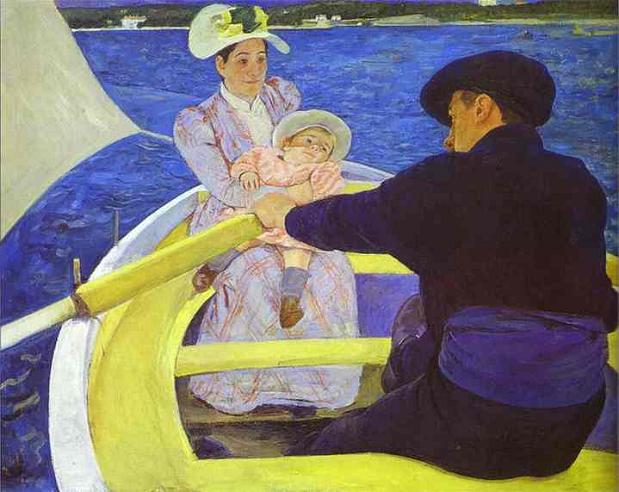
            Painted in 1893-4, Cassatt’s The Boating Party is good example of how gender played a role in art. Cassatt breaks away from placing focus on the male figure in the painting instead places the focus on the woman and her child. Although the male figure is prominent in the picture plane because of how he is place in the foreground, Cassatt seems to keep him anonymous with how she gives the viewer only a glimpse of his face and how is dressed in a darker color keeping him in the “shadows”. The woman and child on the other hand are dressed in lighter colors and are placed in the center of the picture plane directing eyes to them. True to impressionist characteristics, Cassatt paints specific moments and rejects the form of painting that existed before with her removal of spatial depth seen in her consistent brushstrokes creating a flat image.
            The difference are easier to notice when the subjects are similar, as seen in Eakins’ Max Schmitt in a Single Scull painted in 1871. Unlike Cassatt, Eakins’ painting was not focusing on the woman but painted to portray Max Schmitt as a hero. As Eisenman states at a time when rowing was becoming popular, Eakins portrays his friend Schmitt as champion and hero of American life. Eakins also places focus on Schmitt by placing him in the center of the painting and making Schmitt’s figure look at the viewer. True to impressionist characteristics, Eakins depicts a specific moment and how it appears in light.
            In Cassatt’s Woman in Black at the Opera the focus on women remains with her portrait of young woman attending the opera. The female figure in Cassatt’s painting dominates the picture plane is depicted very active. Cassatt has given her opera-goer the power of the gaze which is signified through the use of opera glasses. Her active looking is even emphasized with her fan slightly raised in excitement. The man in the background looks at the opera-goer but she does not acknowledge his gaze, similar to how she does not acknowledge the viewer looking at the painting. Cassatt seems to depict a new type of modern woman, one who takes part in cultural events. The impressionist characteristics present in the painting are that Cassatt paints a visual representation of an experience, which may have never been seen as an important for a male artist to depict. The visible brushstrokes of the painting create a blurry and out of focus appearance to the painting.
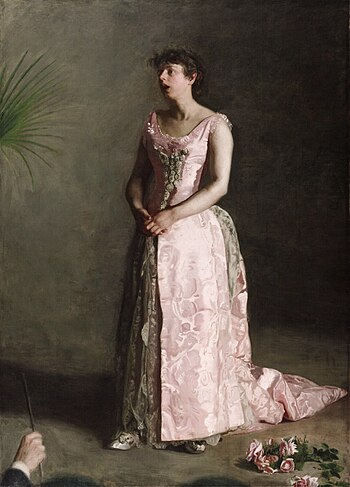
            A less active figure is depicted in Eakins’ The Concert Singer. Although Eakins portrayed Weda Cook actively singing, she seems passive because of her docile pose. Eisenman states that Eakins interprets the singer as an instrument of music rather than a creator of music. This is emphasized through Eakins addition of male hand in the lower left corner which can be seen as sign of masculine control and dominance. Cassatt address this in Woman in Black at the Opera with how the male gaze of the man in the background does not affect the woman in the foreground. The impressionist characteristics observed in Eakins painting are the representation of specific moment and the depiction of the subject as she appears in light. It seems gender and gender roles played an important role in the works of Cassatt and Eakins because of what they considered as important to depict and how it was depicted within the picture plane. 

For more paintings by Cassatt click here

Works Cited
Eisenman, Stephen, and Thomas E. Crow. Nineteenth Century Art: A Critical History. 4th ed. London: Thames & Hudson, 2007. Print.

Gender Gender Gender


One of the products to come out of the Industrial Revolution was the camera, which renders realistic representations of most subjects and at the same time positions realistic painters on the brink of irrelevance. Unable to compete with this new technology painters decided to depict movement, color and moments which created what we know today as Impressionist art. The Impressionism movement was created by a group of street artists during the Nineteenth Century in Paris, France. The style of painting used thin, visible brushstrokes, capturing the change of light, movement, fleeting moments, and focus on common, routine subjects such as those we see every day; flowers, lampposts, and storefronts. This art style also focused on gender with two artists in particular; Thomas Eakins and Mary Cassatt.

Thomas Eakins and Mary Cassatt were both American artists who moved to Paris to further their study of art. Unlike Eakins, who had to rely on his artistic talent alone, Cassatt had the buffer of her wealthy family as well as her talent and ingenuity to become one of the few women to join the ranks of the Impressionists. Both Cassatt and Eakins began their quest as portrait painters who believed that a woman's portrait need not be flattering for it to be successful. Most of Cassatt's paintings revolved around women, their day to day lives and the tasks they performed, but most importantly the relationship between mother and child. Eakins in the other hand chose to depict nature and how man interacted with it.
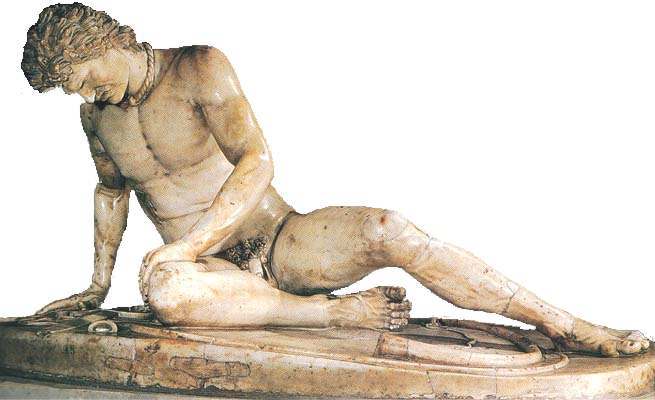
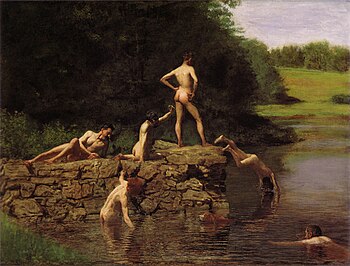
Thomas Eakins' The Swimming Hole depicts a group of nude men swimming happily  enjoying nature's gifts and though this painting is over a century old it shows us that even back then people thought about escaping the social restraints that life had placed upon them. Eakins himself wishes to escape the life he is currently living for he has painted himself in the foreground of this painting. The males are depicted with modesty and some in classical poses such as the case of the male on the far left whose is laying in the "Dying Gaul" pose and the male in the center who is standing in "Contrapposto". Eakins uses the nude males figures and the beautiful landscape to represent the youthful, democratic and free nation that is America and to show how blessed America is when it comes to its natural resources. 
Mary Cassatt's Woman in Black at the Opera depicts a woman watching an opera show without a male escort which was frowned up. Through the woman in black Cassatt expresses what she is going through as a female artist in a patriarchal world. The woman watches the show as other male patrons watch her in disbelief, the woman also doesn't engage the viewer which was never heard of in painting during those days, this is done in a way that tells people she doesn't care what they think about her. She is wearing black because though she is a rebel she also is a little fearful for her safety and is trying to remind as incognito as possible.  

Both Eakins and Cassatt came from different backgrounds, studied under different mentors and took different routes to become very successful Impressionist artists. The subject of each of this artists' paintings were vastly different based on what each artist was allowed to depict in that era.  However, both aim to make a mark in society and put into light social issues that other artist chose to ignore. In the swimming hole Eakins chose to shows patriotism and the love he feels for America, while Cassatt's Woman in black at the Opera inspires women to raise above stupid laws put in place by men to oppressed the female gender. The Impressionist artists as a group show us that even when faced with a dead end you should never give up; you should get your tools out and make a new route that will lead to new possibilities.


Eisenman, Stephen, and Thomas E. Crow. Nineteenth Century Art: A Critical History. 4th ed. London: Thames & Hudson, 2007. Print.

Kleiner, Fred S., Christin J. Mamiya, Richard G. Tansey, and Helen Gardner. Gardner's Art through the Ages. 13th ed. Vol. II. Belmont, CA: Wadsworth, 2004. Print.

Janson, H. W., Joseph Jacobs, and H. W. Janson. Janson's History of Art: The Western Tradition. Upper Saddle, NJ: Prentice Hall, 2009. Print 

Post 2


            Nineteenth century America burgeoned with the energy that only a newly freed nation can muster. It was the birthplace of many new things, incredible ideas, and one-of-a-kind people. Two of these memorable Americans are artists Mary Cassatt and Thomas Eakins. Although artists with disparate styles and subject matters, Cassatt and Eakins interestingly had similar backgrounds. Both natives of Pennsylvania and students of the Philadelphia Academy of Fine Art, these artists left their American homeland to pursue their love of art in France. In Paris, Cassatt and Eakins explored themes of gender and gender roles amidst a larger cultural sense of tension and opposition.
            Cassatt is renowned for her depictions of women as autonomous subjects in her art, a reflection of her own feminist voice. The interesting thing about her female subjects is their total disregard and rejection of the male gaze, making them independent in a two-dimensional form and implying independence in real life as well. This is self-evident in Cassatt’s FiveO’Clock Tea; in this work, the female subjects exist outside of the male context.
            Eakins depiction of men and women was also very interesting. His focus on the male form showed a fascination for boyhood and masculinity; in juxtaposition, his renditions of women make them seem much more lackluster and almost unimportant. However, this is inferred based upon his fixation with painting young male nudes. Swimming Hole illustrates the focus of paintings. These paintings convey the message of freedom and nature unexplored, themes that illustrate the state of America at this time.
            These two artists existed within different art movements. Although contemporaries, Mary Cassatt’s work was undeniably Impressionist. Her brushstrokes were generous though delicate; her canvases were often bathed in a soft light with no pure black. Eakins’ work bordered on Realism; his works explored the sublime qualities of the male nude and showed America’s wilderness with a sharp and crisp technique. In fact, these two artists were nearly opposites; virtually, one of the few similarities they had was painting the male and female in novel ways.
            Essentially, these artists were innovators in their depictions of their respective genders. Mary Cassatt took women and the expression of gender to another level in her art, provoking a dialogue about female independence from men. She found her niche in Impressionism despite her origins in Pennsylvania. Likewise, Eakins took the adoration of the male form from its typical Classical context and redefined it during the Impressionist era, using America as a foundation for his themes of freedom. Perhaps for the first time, we see gender and gender roles redefined in art.

Thomas Eakins. The Swimming Hole. 1844-45. Impressionist.

Monday, October 22, 2012

Gender in American painting, Marry Cassatt and Thomas Eakins


          When we look at American paintings, we hardly see what is uniquely American and what focuses on gender issues. Regionalism was a movement that brought about art that was uniquely American. This movement portrayed the life style of the mid-west, and through this portrayal American painters provoked many questions regarding gender. Thomas Eakins and Mary Cassatt are two American painters that focused on specific gender roles, this allowed us to see male and female views in a different perspective; one that is considered modern. When we examine the works of these two artists, we cannot undermine gender issues by looking at masculinity and femininity, but by looking at the social conditions that both artists portray in their subject matter. Eakins and Cassatt rejected the norm of painting pretty or glamorous portraits of women, but painted them in an innocent, true to life, and unglamorous way. Impressionism allowed both artists to reject the formal aspect of depicting the reality of things, but rather to portray their own sense of gender which was important in their paintings.

            Gender plays an important role, whether consciously or subconsciously. Cassatt and Eakins redefined the roles for both men and women. In the midst of impressionism, Mary Cassatt used an impressionistic quality of capturing the fleeting moment; the intense light quality, feather like impressions of the brush stroke, the intimacy of
portraiture, and the flatness of the surface. Cassatt's, The First Caress, 1890, captures the light filled room that shows the moment of motherhood. Here we see a more intimate, private scene of mother and child; a kind of delicate and innocent moment. Cassatt is able to capture an intimate encounter between mother and child. This subject matter empowers women, and shows the devotional, and dedicational strength of motherhood. Rather than seeing motherhood as a task, Cassatt makes it seem like a ritual, a kind of intimacy that is only privileged to women.


            Unlike the intimate, private depiction of motherhood in Cassatts painting, Thomas Eakins depicts the subject of male heroism. For example, The Swimming Hole, 1883, depicts a scene where nude males gather to swim and enjoy nature in a very public manner, unlike the intimacy in Cassatt's painting. Eakins shows elements of a realist painter when rendering the male figure in classical proportions and modeled after the Greek contropposto pose of Dying Gaul. The male in the middle of the painting also stands in a classical contrapposto pose. Attention to detail is highly regarded in his painting. We also get a sense that Eakins paints the male nude to elevate them to the classical heroic and idealized ideas of the Greek and Romans. We can also see elements of impressionist painting, for example the intensity of the light filling the image, but also capturing refracted light on the water and the sky. We can also see Eakins attention to nature, and his glorification of the scenes depicting American freedom. As an American painter in Paris, he did not forget his roots, and his undying love for the American landscape. This is evident in the traditional painting ways that other American painters before Eakins adopted, such as Thomas Cole.
 
          The invention of the camera takes photography to the height of art, yet traditional art like painting still remains the top contender as well. There is less attention to the realism of the painting, and artists move to a new, more exciting movement of impressionism to capture the essence of image rather than depicting what is reality. Marry Cassatt use it to her advantage. She painted portrait of women that were both powerful, yet sensual which defied the normal roles expected of women. Cassatt's
painting, Woman in Black at the Opera, 1880 acknowledged the male gaze which male artists painted in female nude as an object for male spectators; a man is staring at woman in the back. Cassatt's portrays a woman in the eye of the public, but Cassatt also rejects the gaze by using binoculars to look into the opera. It is quite scandalous for a female artist to paint woman in such power, the power of the oppositional gaze. Cassatt not only captures the impression of the woman in black but she is gives the spectator a different view on gender roles, especially of the high class. The woman in black is not a woman of lower class but a woman of the upper class who is in total control of her position and power. Although the subject is a public event, it still retains a sense of privacy like most of Cassatts paintings.

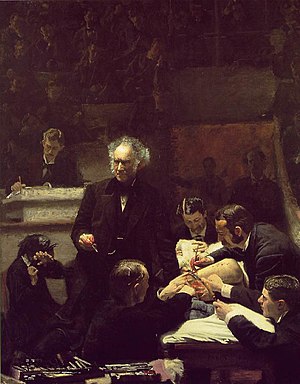
          Back home in America, Eakins produced portraits that speak on the heroism of democratic America. His subjects are still predominantly male figures. In The Gross Clinic, 1875, Eakins takes the subject of operation to a grander scale. He is patronizing the practice of good health and medical advance in America. The main figure in the picture plane is a doctor, a prominent figure in field of surgery. As a realist painter, Eakins also depict the scene is a more detail way with dramatic lighting. It is to capture the moment, a moment in time of the operation. Although it is vividly cruel some yet it is quite modern in it subject matter. The subject here is no longer the dissect corpse but instead a life saving moment. Eakins shows only male as it is a male dominant field and the male protagonist is showing his fellow students how to operate. We see the intensity in the color and the use of light. Altogether, we see Eakins interest in the male figure as his dominate picture plane.

          We see the two different painting style yet they both giving a new and modern in their subject matter. One is quite intimate and private as to portray the life of the upper class especially strong and powerful woman figure. The other is strong in the present of public figure and elevates the figure to a heroic figure. The gender role portray by each artist is subtle yet they are loud. As American painter, they both has open up a conversation of gender different that inscribed in their painting.

Works cited

Eisenman, Stephen, and Thomas E. Crow. Nineteenth Century Art: A Critical History. New York: Thames & Hudson, 2011. Print.
 

Louise Elder Havemeyer and Weda Cook

          American born artists Mary Cassatt and Thomas Eakins were both born during the mid nineteenth century in Philadelphia and were fortunate enough to not have to rely on selling their work to generate income.  Cassatt and Eakins studied at the Pennsylvania Academy of Fine Art and eventually in Europe.  Mary Cassatt settled in France where she flourished artistically within the Impressionist movement while Thomas Eakins kept the United States as his primary residence. Both artists seemed to prefer the creation of portraiture in artistic endeavors. Cassatt and Eakins were similar in upbringing, opportunity, educational experience, and painterly content.  But the way the various subjects manifested in their work were a reflection of their experience of reality through a gendered lens.  Mary Cassatt charged her female figures with autonomy and celebrated the domestic domains traditionally relegated to women.  Thomas Eakins, to the contrary, pictured women as inactive passive characters that were objects of art.   While Cassatt and Eakins both chose to frankly illustrate their female sitters abandoning the method of beautifying their subjects, subtleties of execution illuminated their personal understanding and experience of the social construction of gender.
Mary Cassatt. Portrait of Louise Elder Havemeyer, ca. 1896
          Mary Cassatt's Portrait of Louise Elder Havemeyer, ca. 1896 depicts a suffragist and friend of Cassatt's.  Executed later in her career, this image mirrors the feminist social activism that Cassatt began to embrace and portray in her paintings.  Louise Elder Havemeyer is illustrated with her spine erect and gaze firmly directed at the observer.  Her hands powerfully grip the fabric of her garment and accessory.  As femininely decorous as her gown may be, it visually enhances the size of her form projecting a forthright and expansive femininity.  The subject's frontal orientation coupled with the volume of the adornment cannot be contained by the confines of the canvas and asserts the power of the sitter's character.  The depiction of Havemeyer's face in uncompromising in its realism and is unapologetic about flaws and age.  The manner in which her deep set eyes and broad forehead are painted deviate from the tendency to enhance the beauty of the sitter and rather an emphasis is placed on her inner strengths.  Clearly inspired by the Impressionist movement in France, Cassatt renders Louise Elder Havemeyer's image with a range of pastel colors that highlight brushstroke and color patches that glitter like specks of light.
Thomas Eakin.The Concert Singer (Weda Cook), 1892
          Thomas Eakin's The Concert Singer (Weda Cook), 1892 also illustrates a woman prominent in popular culture for her singing abilities.  Weda Cook is demonstrating her musical talents in this image but appears less active due the way her mannerisms and bodily posture are articulated.  Diagonally positioned and looking dreamily into an unknown space, Weda Cook is pictured as removed from her audience, disconnected from the music she is generating, and disengaged from the the viewer of the painting.  According to Linda Nochlin in Nineteenth Century Art A Critical Art History, "...Eakins interprets the female singer as the instrument of the music that flows forth from her rather than as a creator in her own right." (Nochlin 378).  The Concert Singer is a vessel of the musical vibrations that her vocal chords produce and the male ochestra conductor's hand issuing forth from the left hand corner imparts upon the audience that her talent can only be actualized through the tutelage and manipulation of a masculine counterpart.  Thomas Eakins illustrates his subject with no attempts of enhancing her physical appeal and remains steadfast to his devotion to realism.  Weda Cook is three dimensional and the utilization of modeling and chiaroscuro make this figure seem solid and life-like. The texture of her skin and the finish of her garment are commensurate visually with their existence in the organic world.
          Although similarities in Mary Cassatt's Louise Elder Havemeyer and Thomas Eakins' The Concert Singer exist in the broadest ways, for instance they are both portraits of females, the divergences in meaning are abundantly present.  Surely the fact that Mary Cassatt was a woman and understood the asymmetry of social and political power distributed among the sexes, motivated her to use art as a means to fill the women in her paintings with the qualities of humanity and assertiveness which were usually ascribed to men. Louise Elder Havemeyer portrays a powerful activist that does not exist for the viewing pleasure of men in the painting or in reality.  She was an accomplished individual with the noble pursuit of increasing the rights of women.  The manner in which Cassatt purposefully illustrated these qualities indicates an intention to provoke the questioning of traditional perceptions and manifestations of gender in art and the expression of it within  social arenas.  Thomas Eakins preferred to enforce these socially constructed notions of gender.  The Concert Singer embodies the characteristics that men have traditionally assigned to women: passive, easily manipulated, mentally stagnant, and most effective under the authority of a man.  Louise Elder Havemayer demands the viewer to respect an independently successful individual that sat before an artist and The Concert Singer insists that the woman pictured in its center lacks the ability to conduct herself separate from the assistance of a man and functions more adequately as a submissive item to be visually assessed.
          Mary Cassatt's expression of gender in her art work is disparate from Thomas Eakin's portrayal of men and women.  Mary Cassatt perceived the reality of her own gender through her own personal awareness of oppression and Thomas Eakins, born with the privileges that were attached to manhood, accepted gender normativity and the hierarchy that assumed men at its apex. Cassatt used her portraiture to promote the shift from women solely as objects in art to autonomous meaningful individuals and members of society.  Thomas Eakins used his artistic modality to affirm the belief that women should exist in the shadows of men and remain as objects to view in the visual arts.  Emerging in the art scene within the same social and historical contexts, Mary Cassatt and Thomas Eakins used their cultivated artistic skills to explore gender in ways that sharply contrasted each other.
          
          
Eisenman, Stephen F., Nineteenth Century Art A Critical History, Fourth Edition 2011. 
http://academics.smcvt.edu/shelburnemuseum/sestey/Louisine%20Elder%20Havemeyer.htm          

Cassatt and Eakins: The Views on Gender Role


Mary Cassatt and Thomas Eakins were both 19th century artists, whose primary artistic focus was to represent the beauty of the human form through their many artistic works. Mary Cassatt was an impressionist painter whose main focal point was to embody the importance of the female figure, as well as the role of the women she painted. Cassatt’s concentration was to show the importance of these women in society, by rendering them as the central figures in her works. Cassatt’s concern was to make them the center of attention to any spectator viewing these paintings, so their full focus would be on the women, and the women only. Thomas Eakins was a realist painter, along with many other artistic traits, such as sculpting and photography, who reflected through his works the importance of both the male and female form. His first works concentrated on artistic landscapes. Sometime later Eakins began depicting both female and male portraiture in his paintings. Cassatt focused on the importance of women, while Eakins demeaned their capabilities and roles in society


Mary Cassatt, Women in Black at the Opera House,  1880
            Mary Cassatts’s, Woman in Black at the Opera, (16-13, p. 377, Woman in Black at the Opera, 1880) is a perfect representation of women as the main focus in her artistic works. The importance of the role of the woman in this artistic rendering is symbolically portrayed through her active gestures, and stern look in her face. She is there to be glanced upon, and the attention should be on her and no other. The spectator almost gets a sense of assertiveness, and that she is definitely in control of her surroundings. There is also an intense force of energy through this painting, through the gaze of the character in the painting. Her dark silhouette, against the light of the opera house turns the spectators eyes to her and definitely makes her the main focus in the artistic work.


Thomas Eakins, The Concert Singer, 1892
Thomas Eakins’, The Concert Singer, (16-14, p. 337, The Concert Singer (Weda Cook), 1892), depicts the insignificance given to women in his works. The woman in this painting is not shown as a very active member, therefore not given much importance. The figure is portrayed actively performing, but the lost, faraway look in her face takes the power of her performance away. Her body language, delicate hand gestures, and overall suppleness of the figure reflects loss of control, and in a way demeans her strength as a performer and depicts the figure as bleak, and incompetent. In a sense Eakins gives more importance to her vocal capabilities, and performance, and takes away her power as the proprietor of this gift.

           While Mary Cassatt depicted women as powerhouses of society in her paintings, Thomas Eakins depicted them as unimportant. Eakins works did not reflect on the importance of these women in society. This has come to my attention through the intense analyzation of both of their artistic works. This conclusion can indeed reflect on the views of gender roles of both artists. I do not want to sound cliché, but it indeed had to do with Mary Cassatt being a woman, and Thomas Eakins being a man. Women are more eager to represent themselves in true form, the way they are, and see themselves, while men take their power away, to not come across as mentally emasculated. Men make women come across as frail, and just for simple viewing pleasure when indeed they are equally as powerful as men. 

          In the end, both Cassatt, and Eakins had their own views, and representations of women. Their artistic renderings, and views reflected on the though of the time, when both men and women had different perspectives of their gender roles. A spectator can easily sense this in the style, process, and though put into the figures expressions, and body language in the paintings. One view of the roles in gender is better than the other, mainly Cassatt’s. However, it does not take away from the fact that they were both great artists of their time, and their artistic works were indeed exquisite.


Works Cited 


Eisenman, Stephen, and Thomas E. Crow. Nineteenth Century Art: A Critical History. 4th ed. New York: Thames & Hudson, 2011. Print.

References

Eisenman, Stephen, and Thomas E. Crow. Nineteenth Century Art: A Critical History. 4th ed. New York: Thames & Hudson, 2011. Print.

Kleiner, Fred S., and Helen Gardner. Gardner's Art Through The Ages: A Global History. 13th ed. Boston: Wadsworth, Cengage Learning, 2011. Print.

*Caption on visual works link to photo source

Mary Cassatt and Thomas Eakins

-->
The world of art has always been a kind of “Boy's Club”. Artwork was made by men, and for men. And what was true centuries ago, is still true today: Men want naked women. Of course in the 19th century these sentiments were hidden under technical skills such as composition, brushstrokes, and even colors that were used. Women couldn't possibly understand art, and they were unfairly judged in the French art world, thus receiving less opportunities to showcase their skills. However, as the world began to change, it inevitably affected the art world, thankfully for the better. 

Mary Cassatt, In the Box. 1879.
 In the 19th Century, Impressionism was gaining popularity. Impressionists were concerned with depicting a fleeting moment, and how sunlight affected the subjects they were painting. These artists completely rejected the rules of the prior movements in France. They did not care for depth of field, or realistic depictions. Instead, they utilized visible and bold brushstrokes, and sketchy compositions, which looks "unfinished" to some critics. 

Although Impressionism gained popularity, it wasn't immediately accepted by the critics in France. So much so, that impressionists were often forced to exhibit in salons that they curated themselves. The Impressionists were thought of as the "outcasts" of the art world in Paris. However, these outcasts did not accept other outcasts. Women rarely exhibited any work in French salons.

Of course the male artists weren't the only ones to blame. In the 19th Century, women still fulfilled the generic gender roles imposed by society: They were meant to stay at home, cook, clean, raise kids. Women were not expected to educate themselves or to meddle in politics. The same could be said for the art world. Women were discouraged early on from becoming artists. It was not thought of as an appropriate occupation. Mary Cassatt experienced this first hand. Even though she was born in America, (where we can argue there was a much greater stride for women's rights being made) her father did not approve of her choice to be a professional artist and attend The Pennsylvania Academy of Fine Arts in Philadelphia. In fact, she was born into a prominent family in Pennsylvania, and her father was worried that she would be exposed "to feminist ideas and the bohemian behavior of some of the male students".

Cassatt eventually quit the Academy, because she was fed up with the unequal treatment of male and female students, and left for Europe. She painted in Europe, but had a very slow start. It wasn't until her good friend Edgar Degas invited her to showcase her work at independent salons, that she began to become associated with the Impressionists.

Thomas Eakins, Art Students Bathing. 1884
Thomas Eakins was also an American artist born in Pennsylvania who happened to venture out to France as well. He taught at the Pennsylvania Academy of Fine Arts, the same Academy that Cassatt had attended. Although Eakins falls within the category of Impressionism, his works were far more similar to those of the naturalists. Eakins was very controversial in the way he dealt with nudity. He would often disrobe in front of female students, and would also photograph, and encourage students to model for drawing classes. Eakins believed that male and female students should receive the same kind of education, and was involved in a couple of scandals where he would present himself naked to female students in his own studio.

Although Eakins claimed that he believed in equal education for all, he chose to focus his own personal works primarily on men. Unlike the Impressionists in France, Eakins was fascinated with photography, and there are many photographs that suggest he did not paint "en plein air" as it was commonly done in the movement, but rather used these photos in order to attain composition. Thomas Eakins was known for painting carefree youth located in natural settings, emphasizing the freedom not only of the young American men, but also the freedom of being outdoors, in the presence of nature. 
Mary Cassatt seemed to be more embedded in Impressionist culture than Eakins. Her brushstrokes were less contained, and her compositions were more intimate and concerned with the reflection of light. While Eakins primarily painted men, Cassatt did the very opposite and painted mostly women. For the first time, Cassatt's works depict the female form in a way that does not entirely appeal to the male gaze, as was the norm in the art world of the 19th century, and centuries prior. Her compositions were simple, yet very personal. Almost all of the women in her work do not gaze directly at the viewer. They do not suggestively beckon the male gaze. Cassatt treats her subjects as women, and not objects to be stared at. 
 
Mary Cassatt differs from Thomas Eakins in technique, and in subjects while both are still considered Impressionists. Eakins was primarily concerned with depicting the nude male body, which became a trend in his career. Mary Cassatt did not follow in the footsteps of her fellow artists. She rebelled against her family's wishes and became an artist. Then, she chose to portray women in a light they had never been painted in before: as real women. Cassatt elevated her subjects in a way that made them feel like actual characters and not just subjects of a painting. Perhaps for the first time in history, we see art made by a woman, not created with the male gaze in mind.   


Sources:
Thomas Eakins
Mary Cassatt