Monday, October 22, 2012

Post 2

-->

Artists in the late nineteenth century challenged status quo while those ones in the Renaissance period either lived by it or made mild attempts at speaking out. This major difference was as a result of the social, economic, political and cultural changes that societies underwent during these different art periods. However, because of the nature of art, there were still certain commonalities between these eras.
The Realism and Romanticism of the early 19th century gave way to Impressionism and Post-Impressionism in the later half of the century with Paris being the dominant art capital of the world. Realism was an artistic movement that began in France in the 1850's, after the 1848 Revolution. These Realists positioned themselves against Romanticism, a genre dominating French literature and artwork in the late 18th and early 19th centuries. Seeking to be undistorted by personal bias, Realism believed in the ideology of objective reality and revolted against the exaggerated emotionalism of the Romantic Movement. Truth and accuracy became the goals of many Realists. Many paintings depicted people at work, underscoring the changes wrought by the Industrial and Commercial Revolutions.
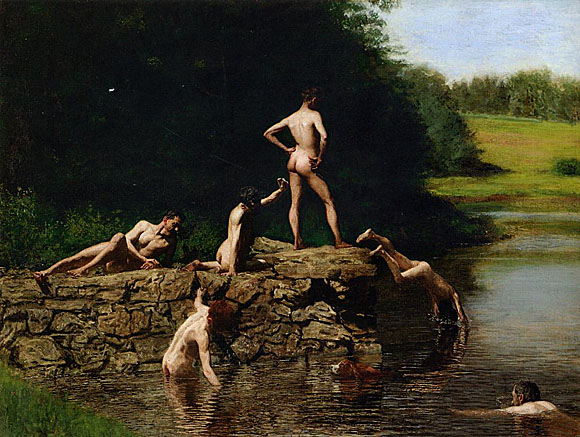
Gender difference not directly expressed in the work in terms of formal structure or inevitable iconographic choice. Gender must be envisioned as a social construct, mediated by historical conditions and the specific situations. Nor must the sex of the artist be seen as always and in every circumstance the determining factor. Both artists refuse to idealize or prettify their female sitters. Often it is a difference created by the subjects’ male and female artists were encouraged or permitted to paint. Gender difference is easiest to discern when a simple opposition in iconography is involved: young men and boys swimming naked out of doors in Eakin’s Swimming Hole (ca. 1883-5). Eakins took advantage of an exception to the generally prudish Victorian attitude to nudity: swimming naked was widely accepted, and for males was seen as normal, even in public spaces. Eakins was the first American artist to portray one of the few occasions in 19th-century life when nudity was on display. The Swimming Hole develops themes raised in his earlier work, in particular his treatment of buttocks and his ambiguous treatment of the human form; in some cases it is uncertain as to whether the forms portrayed are male or female, versus ladies taking tea in an elegant parlor in Cassatt’s Five O’clock Tea (ca. 1880). In the Five O'clock Tea, Cassatt has given equal attention to the family heirloom as to the figures in this rather atypical image of a mundane domestic ritual of afternoon tea.
Thomas Eakins, The Swimming Hole (ca. 1883-5)
Mary Cassatt, Five O'clock Tea (ca. 1880)
The vertical lines of the background wall add depth to the painting while matching in color with the upholstery of the sofa and the tea table. Cassatt's study of Japanese Prints helped her understand that the background of a composition was as important as the foreground. She also realized that creating a tension between the foreground and background would immediately capture the propinquity of vision, as well as help shift focus between reality and perception. Ever since artists began creating art, they have incorporated sexual themes into their work. Ancient civilizations were replete with sexual or erotic imagery, and their relationship to sex and the human body is clear. It could be said that the beginning of all art is the human figure. As children we draw it in stick form. The painters of the Renaissance carried the classical notion of the nude onto the painted canvas. The Pre-Raphaelites of the late 1900's rejoiced in the sensuality of the human form. The cubist and surrealists stretched and strained the figure to its visual limits in the early part of the 20th Century. Americans lead by Thomas Eakins  cherished the nude as the basic building block for the development of young artists. Both Cassatt and Eakins were painters dedicated to the representation of the human figure, primarily the portrait. Yet there are may differences, the one obvious difference is that Eakins was a man and Cassatt a woman.
Mary Stevenson Cassatt, May 22, 1844 – June 14, 1926 was American painter and printmaker. She lived much of her adult life in France, where she later exhibited among the Impressionists. Cassatt often created images of the social and private lives of women, with particular emphasis on the intimate bonds between mothers and children. Cassatt began studying painting at the Pennsylvania Academy of the Fine Arts in Philadelphia at the early age of 15.  A more traditional painter the canvas functions as a transparent window through which we see a vividly reconstituted three-dimensional space with a vanishing point drawing our eye to the horizon. Her brushstrokes are rendered modestly invisible.
Thomas Cowperthwait Eakins, July 25, 1844 – June 25, 1916 was an American realist painter, photographer, sculptor and fine arts educator and educator. He is widely acknowledged to be one of the most important artists in American art history.  For Eakins, portraiture held little interest as a means of fashionable idealization or even simple verisimilitude—it provided the opportunity to reveal the character of an individual through the modeling of solid anatomical form. Perhaps the most impressive painter of the nude working in the United States in the 1870's and 1880's. For Eakins, the nude was both a personal interest and an important academic discipline that he brought back from Paris to a country ambivalent toward the human body. Cassatt’s work erases space and eradicated the temporal factor. He erases as well the meaningful, narrative implications of spatial depth and temporal endurance produced by shadow modeling and linear and aerial perspective and focus on the formal means of construction.
Artists in the late nineteenth century related distinctly from their societies compared to their counterparts in the renaissance. The major difference was seen in the way that the former artists addressed sensitive issues such as class oppression. However, this era was similar with regard to art and society because in both times, artists reflected the attitudes and knowledge of their time. The western tradition of the portrait reached its full development with the stress on individualism initiated by the Renaissance tells us much about the artist. The period when the place where he or she is working, the patron who commissioned the image or free choice of subject.


Works Cited:

Eisenman, Stephen F., Nineteenth Century Art A Critical History, Fourth Edition 2011.
 Finocchio, R. (2004): Nineteenth Century French realism
Nochlin, L. (1978): Realism; Penguin Publishers 


Post 2

The American and European painting in the 19th century went through a very creative process of getting away from the traditional methods of painting and coming out with more of a personal style individualistic approach to painting. During this time there were not a lot of female painters that were represented or respected, and this created tension. Most women from this time were objectified and were not regarded as of importance in society, in some aspects. Men were the dominant force in the art world and mostly portrayed women as either seductive or in other very limited portrayals.

In the case of the artists Mary Cassatt and Thomas Eakins gender plays a significant role in their work, especially in the case of Mary Cassatt, giving women a sense of empowerment and highlighting them in a new way. Thomas Eakins and Mary Cassatt were both American painters and were very much in the midst of this groundbreaking movement in painting called Impressionism. They took there influences and studies in Paris and created some dynamic work that reflected male amid female gender roles.

Of course there were others who in impressionism depicted a new individualistic point in gender like in Manet's, "Olympia", 1863. Oil on Canvas. Using a prostitute as a model and including a black woman which at the time signified animalisitc sexuality, was new and definitely a shock to the art community in depicting the female gender in contrast with the traditional sense associated with female nude models.

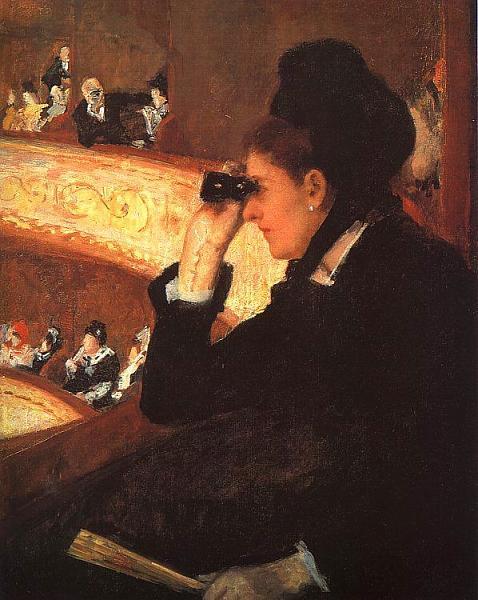
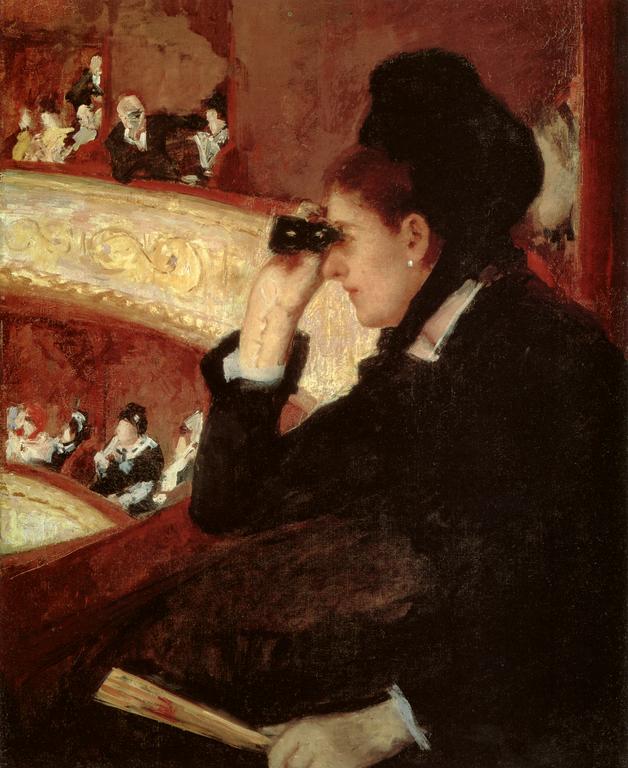
Now one example from Mary Cassatt would be her work entitled, "Woman in Black at the Opera", 1880. Oil on canvas. Here we see right away that the main focus is the woman which is in the foreground and takes up most of the canvas. We have the woman wearing all black which in itself touches on what women had to go through that time. Due to the fact that it was not really accepted to go out alone or in other words, perhaps without a male, they would often times dress in dark clothing or in black when out alone in order to not stand out to the public. So right their there is a significance in female gender roles of the time. Here the women is at the opera, alone and as if she is defying the norm she is seen in control in command viewing the opera through binoculars. She is the women focusing in on the show from above. We also see in the background a man viewing her from across the opera. The women is the focus again. The male is secondary.  Her posture also suggests that she is in control with her leaning towards the edge. She is in the moment. Also she is not looking at the viewer or gazing at the viewer of the artwork directly but is focused and in control. The background is blurred and the light source is in the background as well with brush strokes visible. Clearly the role of gender played a significant role in her work as seen in this piece and many others.

In comparison and in contrast we look at gender role from another artist and how it differentiates. Thomas Eakins piece entitled, " The Concert Singer (Weda Cook), 1892. Oil on canvas. Here we see Weda Cook performing yet she seems timid in a sense, reserved. Also we see that in bottom left corner of the painting the right hand of a male conducting Weda Cook with a conductors stick in hand. Here even though the woman is in center she is not in command due to the small hand in the lower left corner. Her pose seems weak and as if not of her own tuition. She is interpreted by Eakins, "as the instrument of the music that flows forth from her rather than as a creator in her own right" (Thames & Hudson). In other words she is perhaps not capable of creating her own music rather she is the instrument and the male is directing her. She is not in control although she is the focus of this work.
Mary Cassatt's work clearly shows a perspective of women in different roles whether it be motherhood, or women alone, she is focusing on the womens perspective. Thomas Eakins is focusing more on the male gender and most show men in control and in power. They are the focal point in his work and in some cases as in the painting of "The Concert Singer" we see even then that the roles of gender are brought forth according to the artist and the culture of the time.


http://www.metmuseum.org/toah/hd/cast/hd_cast.htm


                                                                  Works Cited

Eisenman, Stephen M. Nineteenth Century Art: A Critical History. 4th ed. New York, NY: Thames & Hudson, 2011. Print.


Post #2


During the late nineteenth century painting was changing as an art form. With the invention of the camera artists started to move away from trying to paint their subject with extreme detail and accuracy. Instead they started to paint things the way they saw them in that moment. Artists moved out of the studio and into the great outdoors focusing on the interaction of light and color. One important subject that these impressionist artists focused on was gender.
One important impressionist artist who mainly focused on gender was Mary Cassatt. Born in Pennsylvania Cassatt moved to Paris during the height of the Impressionist movement.  Being in Paris at this time strongly influenced her work not only by the techniques that she used in her paintings but also in the subject matter of the paintings. Being a woman in a field dominated by men, Cassatt focused her work on women in everyday life. Previous to this most women in paintings were portrayed in the nude due to the almost completely male audience. Cassatt however, painted women in everyday situations so that other women could relate to them.


A perfect example of Cassatt’s female perspective on women is shown in the painting Woman in Black at the Opera. This painting shows a woman sitting in the balcony of an opera gazing through opera glasses at the show while a man gazes at her from another balcony. The painting shows many of the techniques of Impressionist painting. Cassatt’s brush strokes are clearly visible and seem to show a great deal of motion. Woman in Black at the Opera is seen as a contradiction to the idea of the male gaze and the role of women at the time. The woman in the painting is dressed in black so as to hide herself from being seen. This is because during the late nineteenth century women were expected to stay inside the home unless accompanied by a man. The man in the background gazing at the woman is placed in the background to say that the idea of the male gaze is a thing of the past and woman gazing through the opera glasses in the foreground is what the future holds.
  Another artist who concentrated his focus on gender was Thomas Eakins. Eakins, like Cassatt, was born in Pennsylvania but, unlike Cassatt, he remained there for most of his life. Eakins also opposed Cassatt in his focus on gender. While Cassatt focused on women Eakins focused the American Hero.

 
Eakins’ painting Max Schmitt in a Single Scull is a great example of this idea of the American Hero. In the painting Max Schmitt is shown rowing his single scull on a river. In the background Eakins painted himself in another scull rowing behind Schmitt. At the time rowing was becoming a popular sport in France as well as the United States. Schmitt had recently won an important scull race so Eakins decided to commemorate Schmitt as a champion of the sport, an American Hero. While celebrating Schmitt’s accomplishment it also was said to celebrate single scull rowing as a way to escape from the urban confusion.

For more info on Max Schmitt and the history of his race click here

Works Cited:

Eisenman, Stephen M. Nineteenth Century Art: A Critical History. 4th ed. New York, NY: Thames & Hudson, 2011. Print.

Post ii (Eric Ng)


          During the late 19th century, painting was going through changes due to the tension, opposition and technical developments. During this time, Impressionism was emerging and the invention of the camera was taking over how people would see current events. In order to out do the camera, Impressionist were determined to capture the moment of how light would hit the landscape, objects and people.  It was as if Impressionists were trying to capture a mood or memory that was present for a few seconds with quick brushstrokes. During this time was the art capital of the world. Because of that title, Impressionism was being developed there which made other painters want to travel there and explore Impressionism.   
            Mary Cassatt, who was an American painter from Pennsylvania, traveled throughout Europe and ended up in Paris during the middle of the Impressionistic age.  Learning the styles and being influenced by Impressionism, Cassatt became one of the greatest of the Impressionist painters. Because she was a female, it was harder for the viewers (whom were mostly men) to take her work seriously. Up until this point, women were almost always painted nude. This was done solely for the male gaze. The men sought pleasure in gazing upon the female body, which were always idealized.


            Mary Cassatt changed the way that woman were depicted in paintings.  Instead of showing the female body in its fullest, she would depict women in everyday life. In Cassatt’s, Woman in Black at the Opera, she challenges the male gaze. In the painting, Cassatt shows a woman who is dressed all in black, holding a pair of opera glasses to her eyes firmly. She paints the woman dressed in black (in public) to hide her in the shadows. The woman does not want to be seen.  
On the top right corner, Cassatt displays a man, leaning over the balcony, staring at her with his opera glasses.  She places the man diagonally to her. This was purposely done because she wants us to be drawn to him.  Cassatt has the woman holding the opera glasses firmly to her eyes because it represents the “…prototypical instrument of male secular power”. She wants her viewers to know that in this male dominant society, women do have a say in the art world and that the artist (as a woman) can control the male gaze. She is also acknowledging the male gaze by saying that it is not important in this instant. Because Cassatt was an Impressionist, she blurs and crops the painting. They picked up this technique due to the development of the camera.  Impressionists were known to blur their backgrounds to bring forth their subject to the foreground. This also led to the fact that they were Impressionist because they would paint blurred “Impressions” of people and scenes.


           Like Cassatt, Thomas Eakins was also an American painter from Pennsylvania who also ended up in Paris to learn about the Impressionist movement.  He, too, was an impressionist painter who challenged what the art world was about.  Like Cassatt, he would “… refuse to idealize or prettify…” his subjects.  But unlike Cassatt, Eakins would paint his subjects (male) nude. During this time, male figures would be painted nude only if it was portraying a mythical character or god. Eakins decides to challenge this idea in his painting, Swimming Hole. In this painting, Eakins “…projects a heady sense of escape from social constraint through sheer bodily freedom.” The painting depicts a scene of naked men relaxing by a pond or lake, swimming and having a good time. Eakins also portrays himself in the foreground of the painting.  The painting evokes “…moral qualities of honesty and purity in the out-of-doors context.” Unlike most painters who displayed their characters nude, Eakins was not objectifying these men. Instead, he shows them as very graceful people. In this, he was trying to show his viewers what the United States was like- young, new and free. He wanted to show them that the US was free from everything, even clothes. He wanted to show them the male experience and the reality of a man’s everyday life. He did all this in the Impressionist style, with quick, light brushstrokes, and a blurred and cropped out background.  
            In conclusion, Cassatt and Eakins both challenged the art world by doing things outside the norm. They both (in their own way) challenged their audience by making them think about what was really important. By doing so, Cassatt carved out a new path for woman (as an artist and as a gender) to be seen in a new light. Eakins challenged his male audience by making them think ordinary, everyday men could be displayed as nudes in art. Not only were they both influential to the art world, but they were influential to the Impressionist movement as well. Because of the quick brush strokes, the cropping and blurring techniques, Cassatt and Eakins got their message through in the only way they knew how- making Impressions of things they cared about. 


Work Cited:


Eisenman, Stephen M. Nineteenth Century Art: A Critical History. 4th ed. New York, NY: Thames & Hudson, 2011. Print.


Cassatt Woman in Black at the Opera
Eakins, Swimming Hole

Sunday, October 21, 2012

Post 2- Princess Hickmond


The mechanical advancements and social injustices of an era tend to be communicated through art both formally and conceptually; this is characteristic of nineteenth century artists Mary Cassatt and Thomas Eakins. During this period, Paris became a central place for the arts, photography emerged, and a time where a great deal of American artists began to migrate to other countries such as France and Japan. According to John O’Hagan and Christine Hellmanzik’s work Clustering and Migration of Important Visual Artists: Broad Historical Evidence, “Thirty-five of the period’s 72 prominent artists worked in Paris on a long-term basis”; they also state that “Throughout the period, Paris was the most important city by far. Initially, this was because Paris was the birthplace of many prominent artists; then it was because of internal migration to Paris”. Cassatt and Eakins both migrated from America to Paris during this time. As a result, both artists were involved in the Impressionist movement but portray opposing subject manner. This work will examine how Cassatt and Eakins utilize the liberty of Impressionism to communicate their experience and the developments of the social and artistic realms of France; it will also explore the tension caused by gender roles during this period.


In order to thoroughly comprehend the philosophy and methods employed by artists, one must expand their knowledge of the artistic movement the artist was involved in. Cassatt and Eakins’ were both Impressionist painters. Impressionism was commenced from a painting by Claude Monet entitled Impression: Sunrise. Impression: Sunrise. Critics referred to the work as being unfinished in comparison to the work of his advisories seeing that the painting and the art movement was subsequent to Realism. Realist artists focused on exact representation and contemporary subjects such as labor. Impressionist artists deviated from creating an exact representation of subject manner to showing how subject appeared and reflected on subject manner and displaying a visual representation of specific moments. In fact, they rejected the conventions of all prior art movements; as a result, these artists originally operated outside of the Academy. The central premise of Impressionist art was to convey the effects of light on subject manner, capturing the movement and essence of a moment, and concentrating on the application and relationship between specific colors. The formal qualities in Cassatt’s The Boating Party and Eakins’ Max Schmitt in a Single Skull show the Impressionist techniques used by both artists.

Max Schmitt in a Single Skull and The Boating Party are both oil paintings. Both paintings were both painted “plein air”, which according to Nineteenth Century Art: A Critical History,  means painting outdoors. New paints made painting outside allowed simpler for artists. Each has a light underpainting with no application of chiaroscuro or three dimensional modeling which makes the paintings appears flat on a light-filled canvas. Also, they both unexpected cropped their paintings. This transformation was due to the influence of photography and also references to the flat format of Japanese wood block; with the development of photography, artists like Cassatt and Eakins could depend on photography to document the exactness of an event, which allowed them to focus more on other formal qualities of painting. For instance, both artists use water to convey the reflection of light. The paintings both have blurred brushstrokes that were more prominent than those of Realist painters. This directly alludes to the material used and how artists were now accentuating not only the formal qualities, but also the process used to create their works. However, both artists depict the scene with inaccurate proportion. In The Boating Party, the boat is on an improbable angle, and the boat is too foreshortened. In Eakins’ painting, the reflections are on the water too vivid; reflections on water are usually duller than they actually appear. Also, the bodies of water in both works don’t appear to have any depth; it almost appears as if they are on top of a glass or a mirror. Nonetheless, their utilization of both warm and cool colors adds to the variety of textures, showcases hierarchy of elements, and most importantly, shows the effects of the light at this specific time. There are slight differences such as the lack of landscape in Cassatt’s in comparison to Eakins, and the people being a central point in Cassatt’s and not as imperative in Eakins work. Nonetheless, each emphasized the distinctive traits attributed to Impressionist painters. However, though the paintings related formally, the paintings differ significantly conceptually.

As previously stated, each painting depicts the artist’s own experience. Eakins’ Max Schmitt in a Single Skull showcases an oarsman on the single scull enjoying a popular leisure of France. He uses his work to symbolize heroic, freedom. There are only oarsmen on their boats exploring and enjoying the grandeur of the French landscape. In contrast, Cassatt depicts a woman and her child as the focal point of her painting. There is a man present but his identity is insignificant and his sole purpose is to transport this woman and her child to their destination. Both paintings immediately address the fact that men how men typically were outdoors, and how women weren’t out unless they were in the presence of a man. The absence of women in Eakins painting just showcases his depiction of the moment; at the moment, there were no women-just men taking pleasure in an activity explicitly for men. This is an appeasing subject manner for their audience since most of the viewer would be men of the academy. However, Cassatt created her work to not only call more attention to the women but to also elevate a moment between mother and child. She takes an everyday moment and captures it which stresses the fact that this moment between mother and child is important enough to be painted; this wasn’t an aspect explored earlier. Berthe Morisot’s work Psyche also further explicates the gender roles of this era.

Psyche represents a Greek deity Psyche becoming aware of her sexuality as she hesitantly gazes at herself. The issue s of women finding their identity, sexuality, and aging were topics widely discussed during the nineteenth century in paintings, poetry, and even medically in regards to sexual activity while married. For example, in Rachel Mesch’s text Housewife or Harlot? Sex and the Married Woman in Nineteenth-Century France, states that “Balzac's opposition between housewife and harlot reflected, I believe, a deeply felt cultural anxiety about the integration of female sexual desire into a broader female identity. It was an anxiety that stemmed in large part from the likely difñision of the husband's power over the wife resulting from the expansion of her identity.” Women, up until then, were not as avid about their roles in the social or inner realms of their homes. Consequently, men were not only mandating what they did but also who they were as women. When this was painted, more women were being to come to the forefront as artists and gender roles where being further discussed and portrayed in works. Morisot’s purposeful choice of that particular moment showcases the awkwardness of a symbolic woman apprehensively finding her identity and sexuality, without a man. After researching the topic of aging as well, one can say that Psyche, in reference to the average French women, was afraid of not only her growing sexually but also the idea of getting older. For instance, in Gretchen Schultz’s essay entitled Through the Looking Glass: Reflections of Aging Women in the Poetry of Nineteenth-Century France, she stresses that men tend to die earlier than women. As a result, women would face poverty along with physical and emotional illness when they eventually aged. Nevertheless, when a woman faces menopause, she’s no longer viewed as attracted although men her age can freely remarry. Schultz affirms that by saying that “Medical and popular opinion considered menopause (‘itself a catastrophic experience’, Stearns, p. 45) to bring about the loss of desire and, due to the cessation of the reproductive function, to signify old age for women. And yet men were deemed productive and still eligible for remarriage at a much later chronological age”. Women of the time rightfully feared aging due to the fact that most, without their husbands, were poor. They would be rendered unattractive, and could potentially die alone. In fact, the only prominent painting I found of an older woman was by fellow Impressionist painter Cezanne. The recording of these gender roles through artistic methods allows contemporary artists to further examine the state of sexism and evaluate the progression that’s actually been made up to date. However, this exploration of subject manner both conceptually and formally wouldn’t have been achievable without the flexibility of the Impressionist movement.

Though the artists present opposing views, both Cassatt and Eakins present a subjective perception of their experiences. Eakins’ works highlight the heroic, free, youthful pursuits of both French and American men whereas Cassatt vitalizes the events the average women encountered that were initially ignored by the art beforehand. Nonetheless, the deviation from conventions of prior art movements, like Realism, allowed French artists to showcase their works without it being based on social responsibility, war propaganda, emotion, or mathematical calculations. This freedom from art conventions allowed artists to be more expressive than ever before and highlight overlooked subject manner and new artistic methods; as a result, artists like Cassatt could more freely illustrate scenes of women who weren’t goddesses or depicted as objects.  This also allows contemporary artists to more thoroughly examine the lives of women as a part of society and also as artists. Comparing both Cassatt and Eakins’ works allows the viewer to become familiar with the experience of both male and female artists, American artists that migrated to Paris, and also the mechanical and social changes taking place during the nineteenth century.


References:

Eisenman, Stephen M. Nineteenth Century Art: A Critical History. 4th ed. New York, NY: Thames & Hudson, 2011. Print.

Mesch, Rachel. Housewife or Harlot? Sex and the Married Woman in Nineteenth-Century France. Journal of the History of Sexuality .2009

O’Hagan, John. Clustering and Migration of Important Visual Artists Broad Historical Evidence. Evidence Matters Historical Methods. Volume 41. Number 3. Heldref Publications. 2008. Print.

Schultz, Gretchen. Through the Looking Glass: Reflections of Aging Women in the Poetry of Nineteenth-Century France .Romance Studies, Vol. 26 (3). 233–248. July 2008

Saturday, October 20, 2012

Oppositional Tension: Cassatt and Eakins, Subject, Artist, and Technique


Alejandro Hincapie


Mary Cassatt. Five O'Clock Tea. 1880.*
                  If both tension and opposition existed in American and European painting in the late 19th century, it is observable in the delicate relationship between artist, their subject, and his or her technical approach to their work. Indeed, Impressionism in France as an artistic movement and mode of expression faced criticism regarding the seemingly contradicting interplay between its very sensibility and its chief practitioners—a criticism whose basis rested on cultural constructed notions of femininity and what their translation into technical sensibilities in art ought to look like. The warmly intimate work of Mary Cassat, an American born Impressionist painter, provides a unique unraveling of these notions. Meanwhile, American painting itself, long grounded in the tradition of landscape, began a shift of focus towards figural subjects long favored by the European art establishment--a change heralded by the work of Thomas Eakins. While his work slightly referenced French Realism in technique, it did not follow that genre’s bent towards depicting social reality and conditions. Rather, it was vaguely heroic and measured in probity as it rendered “in the moment” Impressionistic reality, as well as offering a distinct take on male subject matter. 
                  Before examining Cassatt’s work, it’s important to consider the conditions under which she was able to reach recognition and praise as an Impressionist painter. A reaction to the sweeping and massive changes brought on by the Industrial Revolution that transformed French life in often brutal and chaotic ways, Impressionist works were created in an attempt to, as Kleiner states in Gardner’s Art Through the Ages, “capture a fleeting moment… by conveying the elusiveness and impermanence of images and condition” (Kleiner 823). This desire by Impressionist artists to capture the fleetingness of everyday life in light of the rapid and dissonant changes spurred on by industrialization was also formed by the onset of photography—a medium that effectively rendered accomplished the long held goal of Western oil painting to depict scenes as realistically as possible. The convergence of these factors led Impressionist painters to create works that sought to capture the nature of everyday life’s fleeting moments—the “impression” of those moments— through ways the camera could not and in ways European oil painting had never attempted. Largely focusing on brushstroke, from, shape, and color, the Impressionists rejected traditional formal elements in chiaroscuro and accurate perspective and modeling in favor of focusing on the effects of light on color and texture to capture distinct, passing moments in time. With brushstroke, color, and mere impression of form taking prominence, Impressionist works appear flat, wholly embracing the canvas as a two-dimensional medium and plane. This new abstraction and rejection of tradition spurred much criticism towards Impressionist works—namely, that, as Eisenman puts it in Nineteenth Century Art – A Critical History, “they were merely unfinished sketches” (Eisenman 368). The “impulsiveness, sensuousness, and lightness of touch” of Impressionist works were deemed more characteristic of women’s nature and therefore at tense, opposing odds with the fact that Impressionism’ leading vanguard consisted almost entirely of male artists (Eisenmen 368).  And precisely because women created them, the works of Berth Morisot and Mary Cassatt escaped much of this criticism and instead, were “praised for possessing charm, sensibility, grace, and delicacy” (Eisenman 368). 
                  That their work was praised for its Impressionist technical sensibility while Impressionist works my male artists were designated as “unfinished sketches” for that same sensibility is not to say that the works of Morisot and Cassat did not bring their own subjective, emotional tug distinct from male artists to their work. Cassat’s work of female subjects, in particular, contains a certain warm intimacy achievable only perhaps through a women’s point of view. Her work Five O’Clock Tea, for example, is a candid depiction of a pair of women “as they are.” Depicting Cassatt’s sister Lydia and a visitor involved in “the ceremony of innocence” of tea drinking, the painting is set in the artist’s Parisian drawing room and candidly portrays bourgeoisie everyday life, specifically the female domestic sphere. (Eisenman 374). There is no sense in the work that both female subjects are in display for the supposed male viewer. Indeed, neither of them is beckoning the viewer nor acknowledging him with a glance. They are made entirely free of the burden of being a passive, female subject to an active, male viewer because, again, the latter is not acknowledged by them and therefore, rendered unimportant, if not nonexistent. Both women are depicted “in the moment,” creating a sense of warm intimacy which is only heightened by the lack of cold, logically-based formalized sense of perspective and modeling in the work. The combination of subjective brushstroke, from, and color, candidness and immediacy of the scene, as well as Cassatt’s own nuanced rejection and lack of acknowledgment of a male spectator creates a work that is wholly Impressionistic, but distinct to the artist and in the way she presents gender. 
Thomas Eakins. The Swimming Hole. 1883-5.*
                  The work of American painter Thomas Eakins also demonstrates an interplay between technical sensibility and subject matter, namely the male subject. While creating a work at the same time as the French Impressionists, Eakins was a more formal painter, still retaining elements of traditional formal technique as is evident in his painting Max Schmitt in a Single Skull. Referencing the Realists before him, Eakins still employed accurate, three-dimensional space with a near (foreground), middle, and distant (background) space as well as a subtle modeling of forms through light chiaroscuro. But while he may have lightly nodded towards Realism through technicality, his work was at tense odds with Realism’s portrayal of acute social conditions. Rather than depicting things “as they are,” Eakins imbued his work with a certain heroism, honor, and allegory even if the portrayal was Impressionistic in it’s capturing “a moment in time.” 
                  This nuanced sense of heroism and allegory is best observed in Eakins’ work The Swimming Hole. Depicting a group of young, male nudes out for a swim outdoors, the work is an allegory comment on American characteristic freedom, and vitality. The young, male body in American scenery becomes a symbol for these values. As Eisenman states, “democratic freedom is signified by the youthful male American body n the American landscape: to be American is to be natural and to have a privileged relation to Nature”  (Eisenman 373-374). With notions of national identity and representation being so intertwined with patriarchy in the 19th century, it becomes clear to view Eakins work as a portrayal of the male experience from a distinct male perspective. 
                  In the works of both Mary Cassatt and Thomas Eakins, the opposition and tension present in European and American painting in the late 19th century is visible in the relationship between the artist, subject, and technical sensibility employed. While notion that Impressionism suited a “woman’s touch” unraveled in the recognition Cassat enjoyed for her warmly, intimate works of female subjects that a wrought with her own female sensibility, completely independent of Impressionistic technique. Eakins, while nodding to Realist technique, deviated from Realist subject matter in his portrayal of heroic, allegorical, and honorable male subjects while still mantaining  “in the moment” Impressionistic sensibility. Juxtaposed, the work of both artist reveals different takes on gender in 19th century artist.  

Works Cited

Eisenman, Stephen, and Thomas E. Crow. Nineteenth Century Art: A Critical History. London: Thames and Hudson, 1994. Print.

Kleiner, Fred S. Gardner's Art through the Ages. a Global History. Boston, MA: Thomson, 2009. Print.


*Image descriptions link to image source. 
**New York's Metropolitan Museum of Art houses an extensive collection Eakins work. Vist the Met's website here.